Get Full Government Meeting Transcripts, Videos, & Alerts Forever!
Get email alerts on the Occupation Integration topic
No spam. Unsubscribe anytime.
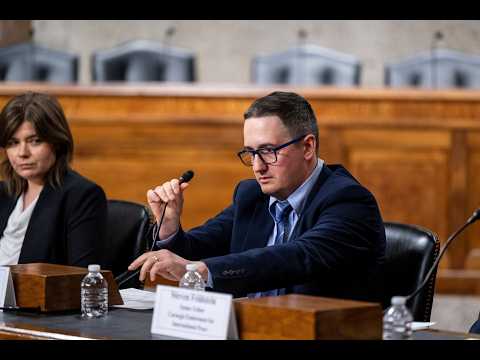
Presenter warns Russia is enforcing permanent integration of occupied Ukrainian territories
Summary
A presenter at a Helsinki Commission briefing described a multi-pronged Russian strategy in occupied Ukrainian territories — administrative integration, information isolation, citizenship pressure, cultural erasure and surveillance — saying the measures threaten Ukrainian identity and daily safety for millions.
A presenter at a briefing of the Commission on Security and Cooperation in Europe (Helsinki Commission) said Russia has moved to make its control of occupied Ukrainian territories permanent, combining administrative integration, information controls, demographic incentives and coercive policing.
The presenter said "the situation in occupied Ukraine remains deeply concerning" and that for "approximately 5 million" people living under occupation there is "a constant struggle for survival on a daily basis," citing routine document checks, surveillance, phone inspections and the risk of detention for perceived disloyalty. The speaker said these measures are part of a broader system "designed to permanently integrate occupied territories into the Russian state, erase Ukrainian identity, and suppress any form of resistance." (Presenter)
Why this matters: The presenter framed the measures as multidimensional and mutually reinforcing, not isolated abuses. He argued that institutional steps taken since 2022 aim to absorb occupied regions into Russian federal systems — including recent digital links to a federal monitoring platform described as a "governor's dashboard" that tracks budgets, personnel performance and construction projects in real time — which makes reversing the process more difficult.
The presenter outlined several mechanisms. First, he said, Russia has replicated federal administrative architectures inside occupied areas and integrated them into Russian digital oversight platforms. Second, Moscow has isolated communities from Ukrainian information channels and promoted Russian-controlled apps and media. Third, access to services, employment and property rights has increasingly depended on accepting Russian citizenship, which the presenter said has been linked to military registration and mobilization.
The presenter also described systematic cultural and educational changes: Russian authorities have, according to the speaker, banned the Ukrainian language in schools, removed Ukrainian books, restricted remote Ukrainian education opportunities, and introduced militarized education programs and youth organizations to promote pro‑Russian narratives.
On enforcement, the presenter said surveillance and policing operate together with technological tools to identify and punish dissent. He listed measures including CCTV, mandatory biometric SIM registration, phone searches at checkpoints and unannounced home searches, and said this environment has produced detentions and transfers to "filtration sites or prisons." The speaker gave a figure of "around 15,000" detentions between 2022 and 2025 but added the true number "might be significantly higher." (Presenter)
The presenter also described incentives aimed at reshaping demographics: higher salaries, subsidized mortgages and relocation offers for Russian teachers, doctors and cultural specialists willing to move into occupied areas.
The session did not record any formal votes or legal actions by the Commission; the presentation was descriptive and intended to inform policymakers. No named legal statutes or ordinances were cited during the remarks.
The presenter concluded that the combined effect of administrative coercion, passportization, surveillance, indoctrination and demographic policies is to make reintegration with Ukraine "virtually impossible." The Commission did not take a vote at the close of the briefing.