Get Full Government Meeting Transcripts, Videos, & Alerts Forever!
Get email alerts on the Greenway Bridge topic
No spam. Unsubscribe anytime.
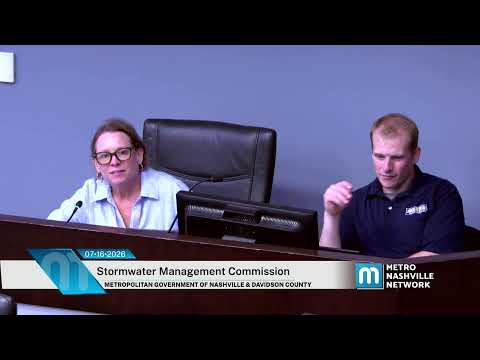
Stormwater commission approves Bellevue greenway and bridge variances, conditions no-rise certification
Summary
The Stormwater Management Commission approved variances enabling a 12-foot ADA-compliant Harpeth River greenway extension and a multimodal bridge tied to the Arisa (Cypressbrook) Bellevue development, but required a Metro no-rise certification before grading or construction may proceed amid neighbor concerns about flood impacts and notice.
The Metro Nashville Stormwater Management Commission on July 16 approved stormwater variances to allow Cypressbrook to extend the Harpeth River Greenway and build a multimodal vehicular bridge as part of the Arisa Bellevue development, but the commission required a Metro ‘no rise’ certification before any grading permit or construction begins.
The commission’s staff described the request as disturbance of the floodway and stream buffers to build a 12-foot impervious, ADA‑compliant greenway and a vehicular bridge with an angle greater than 15 degrees and within 1,000 feet of an existing pedestrian crossing. Staff noted the project connects a missing greenway link, dedicates roughly 20 acres of land to Metro Parks, and includes mitigation measures that staff said meet agency requirements.
Applicant representatives said they had coordinated federal and state permits, including a FEMA conditional letter of map revision and an individual TDEC ARAP, and presented a mitigation package they said provided more than 7 acres of mitigation for about 2.6 acres of disturbance. Scotty Burnet, the applicant’s landscape architect, summarized site constraints and the bridge geometry and said the design achieves a no‑rise condition: “We did study two alternative concepts within the 15 degree skew. These caused adverse impact and caused a rise. Therefore, we are showing the preferred alternative on the left. That’s what we have before you, and that was approved before.”
Residents and technical experts urged the commission to deny the variances or to require stronger proof. Engineer Jim Rossi, who said he reviewed the hydrology, argued the available study “does not meet this burden” for the legal no‑rise standard and warned the applicant’s table showed some increases in modeled flood elevations. Devin Schultz, president of the Harpeth Crest Homeowners Association, told commissioners, “No rise means no rise,” and asked the commission to require evidence now rather than later.
Commissioners questioned whether FEMA’s CLOMR process sufficiently demonstrates Metro’s no‑rise standard and discussed whether temporary construction methods could cause short‑term impacts. The applicant said it had removed a previously proposed temporary construction crossing in response to opposition; the removal did not change net disturbed acreage but altered staging geometry.
Commissioner [functional_label: Commissioner] moved to approve the variance package as presented, with conditions that remove the temporary crossing option and require a no‑rise certificate before any grading permit or construction. The motion was seconded and the commission voted to approve the request; the chair announced the motion carried.
The decision includes conditions and follow‑ups the commission can enforce before construction. The applicant said Metro Parks will accept long‑term ownership of the bridge if dedication proceeds and the applicant will submit the project record materials to the commission. The commission recorded multiple written comments and attachments in the case file; several residents said they would continue to press technical and legal questions about flood‑elevation modeling.
The commission’s approval allows the project to move forward to the next permitting and engineering steps, subject to the condition that Metro receive and accept an independent no‑rise certification before permits are finalized.