Get Full Government Meeting Transcripts, Videos, & Alerts Forever!
Get email alerts on the Charter Schools topic
No spam. Unsubscribe anytime.
Montana Board of Public Education interviews multiple charter applicants, probes finances, partnerships and staffing
Summary
On Zoom the board heard seven charter applications — from trades and rural alternative academies to a hospital‑partnered health sciences program — pressing applicants on enrollment forecasts, facility plans, special‑education supports and how state funding (basic entitlement/A&B) will apply to first‑year budgets.
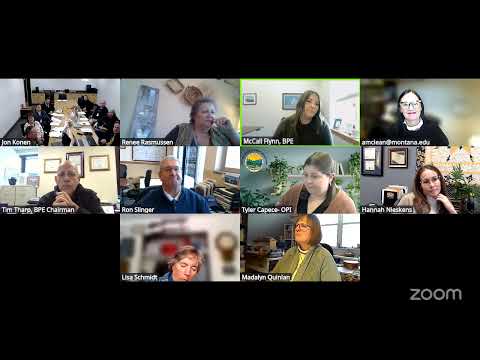
The Montana Board of Public Education on Monday conducted a full day of Zoom interviews with public charter school applicants from across the state, pressing presenters on financing, staffing and partnerships as it prepares recommendations for its January meeting.
Board Chair Tharp opened the session, the board adopted the agenda on a voice vote, and Executive Director McCall Flynn outlined the interview format — 10 minutes for applicant introductions, 15 minutes for board questioning and five minutes for public comment. "We will interview 5 applicants before we take a lunch break... and then we will interview 2 applicants after lunch," Flynn said as the board explained public‑comment and submission procedures.
The board heard a range of proposals. Columbia Falls Superintendent Corey Jopko presented a Columbia Falls Trades Academy aimed at preparing students for HVAC, electrical, plumbing and construction work, saying the model was born from local workforce shortages: "The whole vision of the Columbia Falls Trades Academy came about, when we were experiencing some workforce shortages in our old remodel and work on the high school," Jopko said. He identified Canyon Elementary in Hungry Horse as an available facility and described discussions with Flathead Valley Community College about academic supports.
Flathead Valley Community College President Jane Karas told the board she was not involved in developing Columbia Falls’ application and said, "before this application was sent in, we were not contacted," clarifying the college’s role as an interested but initially uninvolved potential partner.
Miles City Superintendent Megan Brown presented the Custer County CLASS Academy, a blended 7–12 program intended to serve students who need flexible or alternative schedules. "If approved, the Custer County Class Academy would be the 1st public charter school established east of Billings, Montana," Brown said, and she described a stakeholder survey the district conducted that showed strong local support. Board members probed differences between fully remote options and homeschooling, and whether the budget assumptions reflect the state basic entitlement and A&B funding in year one.
Livingston’s Park Pathways team described a proficiency‑and project‑based 7–12 model built around instructional advisors and community internships; proponents highlighted letters of support and a community outreach process. SOAR Academy (Florence) argued for a trauma‑informed, mastery‑based 7–12 charter emphasizing embedded mental‑health supports and flexible scheduling.
Stevensville presented two related proposals: STEPS, an alternative/high‑flexibility program that grows the district’s existing alternative‑learning center, and a Health Science Academy, developed with Bitterroot Health. Stevensville staff said the health academy already offers a dual‑enrollment health‑occupations course and field placements at the hospital; CTE instructor Britney Latham described hands‑on clinical placements and the advantages of early exposure to health careers.
Board members repeatedly focused on three crosscutting issues: (1) finances and the board’s interpretation of state funding rules — presenters cited differing assumptions about whether new charters receive 80% or 100% of the basic entitlement in year one and whether A&B funding is available immediately; (2) staffing and licensure — several applicants proposed using professionals with Class 4 licenses or contracting with community college faculty and hospital staff to deliver career‑technical courses; and (3) facilities and scalability — presenters described using existing district buildings, vacant commercial sites, or partnerships to create lab and workshop space.
Industry and education stakeholders spoke in public comment to support workforce alignment. Jenny West of the Montana Manufacturing Extension Center said workforce shortages "have been a real issue for manufacturers across the state for the past several years," and multiple local employers and community college leaders described demand for career pipelines.
On process, Executive Director Flynn asked board members to complete committee evaluation forms by Jan. 2 so the charter committee can compile recommendations ahead of the board’s January meeting. The board paused to take up additional interviews later in its schedule and adjourned the session after the last scheduled presentations.
Next steps: the Board of Public Education staff will compile board feedback and updated budget guidance related to entitlement/A&B questions and circulate that material to board members before the committee meets to prepare a January recommendation.