Get Full Government Meeting Transcripts, Videos, & Alerts Forever!
Get email alerts on the Rural Health Data Tools topic
No spam. Unsubscribe anytime.
NNLM webinar highlights rural health data tools and demographic trends
Summary
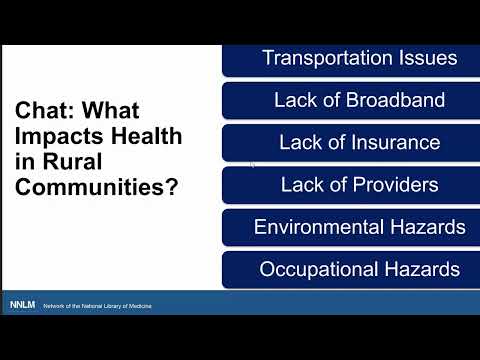
Sarah Levinlederer of NNLM Region 7 demonstrated federal and nonprofit data tools—USDA ERS, the Rural Health Information Hub and MedlinePlus—and summarized key rural trends: net in-migration, an aging population, growing racial diversity among children, and persistent rural poverty and provider shortages.
Sarah Levinlederer, an outreach and education coordinator with the Network of the National Library of Medicine Region 7, led a webinar demonstrating federal and nonprofit resources for rural health data and program planning. She guided attendees through the USDA Economic Research Service (ERS) site, the Rural Health Information Hub (RH Hub) and MedlinePlus, and highlighted demographic findings relevant to rural health planning.
Levinlederer opened by asking participants to think about what 'rural' looks like in their communities, then explained why definitions matter: the Office of Management and Budget and the Census Bureau use different geographic units, and those choices can change whether a community qualifies for particular grants or programs. "When you're applying for funding or programming, be aware of what definition they're using, because that may change whether or not your community is eligible," she said.
Why it matters: program eligibility, funding applications and service planning often depend on the technical definition of 'rural.' Levinlederer pointed attendees to ERS state fact sheets and RH Hub tools that translate multiple definitions into clear yes/no guidance for specific ZIP codes or counties.
Major data takeaways and tools Levinlederer summarized key findings from ERS's Rural America at a Glance and other sources: ERS shows recent net in-migration to many nonmetro areas even as natural growth (births minus deaths) remains negative in places; rural populations are aging faster than metro areas; and health-care and social-services employment increased in 2023–2024. She cited a University of New Hampshire Carsey School brief showing that nearly one-third of rural children (32.5%) are members of racial or ethnic minority groups, up from 28.1% in 2010. "Rural America is becoming more diverse," she said, and noted that poverty and racial disparities are often larger in rural areas than in metropolitan ones.
Levinlederer described rural hospital pressures drawn from an American Hospital Association report—low reimbursement, staffing shortages, low patient volumes, regulatory barriers and high operating costs—and explained the Centers for Medicare & Medicaid Services Rural Emergency Hospital (REH) designation (effective January 2023), which preserves emergency departments while ending inpatient services; she said about 32 hospitals in 14 states had converted under the REH model according to the report she cited.
Demonstrations and practical guidance During the live demo she showed ERS's state fact sheets, charts of note and Tableau visualizations, emphasizing that the site provides both polished charts and underlying datasets for download. She highlighted a chart showing a roughly 36% increase in home-health establishments serving nonmetro areas from 2010 to 2023, linking that to demographic aging and growing demand for elder care services.
On the Rural Health Information Hub, Levinlederer demonstrated state guides, topic pages (for example, rural health clinics and federally qualified health centers), map-based facility listings and a tool that evaluates whether a community qualifies as rural under different federal definitions. Using Farmington, Maine and Bayfield County, Wisconsin as examples, she showed how RH Hub flags primary care, dental and mental-health shortages and lists funding opportunities that are restricted by state or program.
MedlinePlus and content use Levinlederer reviewed MedlinePlus as a plain-language NLM product for patients and providers, showing health-topic pages, the medical encyclopedia and clear labels that show whether a link stays on MedlinePlus (NLM) or goes to an external source such as NIH or RH Hub. She demonstrated the bilingual (English/Spanish) toggle and explained that ERS materials are open source with required attribution; for other resources she advised contacting content creators when in doubt.
Questions and next steps Attendees asked about reuse permissions and data sources; Levinlederer pointed out chart metadata that often names the underlying source (for example, the National Center for Health Statistics) and recommended contacting the original data owner for verification when necessary. She reminded participants that completing the session evaluation is required to receive continuing education credits and shared contact information for Region 7 assistance and for referrals to other NNLM regions.
The webinar closed with a reminder that County Health Rankings will be sunsetted at the end of the year and thus will stop producing new reports after funding ends; Levinlederer encouraged attendees to use available datasets while they remain active and to save relevant charts and data for future work.