Get Full Government Meeting Transcripts, Videos, & Alerts Forever!
Get email alerts on the Sb1 Guidelines topic
No spam. Unsubscribe anytime.
California Transportation Commission previews 2026 SB 1 guideline updates, adds land-use supplement and transit-priority language
Summary
Commission staff presented a consolidated land-use-and-housing supplement for the 2026 SB 1 programs and proposed edits to the Solutions for Congested Corridors and Local Partnership competitive programs to explicitly reward first- and last-mile transit connectivity, with formal adoption targeted for August 2027.
Staff from the California Transportation Commission used a final public workshop to present proposed 2026 updates to SB 1 program guidelines, including a consolidated land-use-and-housing supplement and edits intended to prioritize transit-priority infrastructure and first- and last-mile connectivity in competitive scoring.
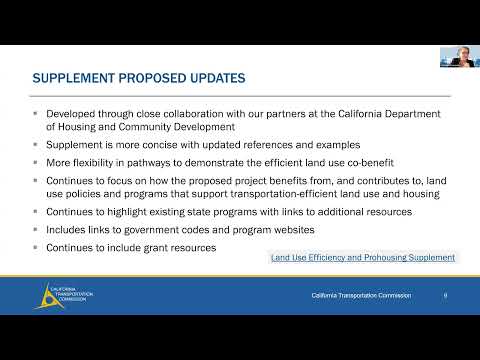
Leshara Ward, associate deputy director for the Local Partnership Program, led the workshop and said the supplement consolidates guidance for the Solutions for Congested Corridors Program (SCCP) and the Local Partnership competitive program into an identical appendix intended to make it easier for applicants to demonstrate how projects support efficient land use and housing. "The 2026 supplement is more concise than the 2024 version," Ward said, adding staff revised references, examples and built in clearer pathways for applicants.
Naveen Habib, associate deputy director for the SCCP, said the supplement organizes applicants' options into five pathways — pro-housing designation; transportation-focused pro-housing policies; indicators of efficient land use; ongoing investment and partnerships; and partnership and facilitation — replacing a prior structure she described as more fragmented. "We have five clear pathways instead of kind of the more ambiguous language," Habib said, noting the change is meant to simplify how agencies respond to the evaluation criterion.
Commission staff highlighted concrete document changes that will affect how nominations are evaluated. Habib pointed to two clarifying additions to the SCCP evaluation criteria (section 17.2.06): explicitly listing pro-housing designations and transportation-focused pro-housing policies among acceptable policy evidence, and asking applicants to show how a project aligns with ongoing investments, partnerships or coordination efforts.
Matthew Yazcott, deputy for SB 1 programming, framed the proposed edits in the context of Governor's Executive Order N-7-26, which he said directs state agencies to accelerate transit project delivery and "make public transit faster, cheaper, and easier to use across California." Pursuant to that order, Yazcott said staff recommend adding language to SCCP and LPP competitive eligibility and accessibility criteria so projects that promote transit priority and first/last-mile connectivity are evaluated more competitively.
Yazcott described the first/last-mile infrastructure the guidelines would call out as eligible and promotable: transit signal priority, bus-only lanes, bus-on-shoulder configurations, microtransit, micromobility access and active-transportation connections to transit stops. "We're talking about public microtransit, micromobility access to community members, and active transportation to and from transit stops," he said. He also noted the SB 1 transportation equity supplement already treats first/last-mile improvements as a benefit to disadvantaged or marginalized communities under community engagement and equity scoring.
Staff also walked through practical resources included in the supplement: a site-selection mapping tool for identifying major transit stops, high-quality transit corridors and average per-capita vehicle miles traveled; sample local-practice examples from multiple California jurisdictions; and links to state and federal programs applicants can cite. The Department of Housing and Community Development contributed to the updated supplement and was acknowledged as an available resource for questions.
The Commission's schedule for finalizing the guidelines was shared in the workshop. Staff asked for written and verbal feedback by July 17; materials for the August Commission meeting will be posted by Aug. 7; SCCP requires two statutorily mandated regional public hearings (Aug. 3 for the North hearing and Aug. 20 for the Southern hearing) before adoption consideration; nominations will open after adoption, with LPP competitive nominations due Nov. 18 and SCCP nominations due Nov. 19; staff aim to release recommendations in June 2027 with program adoption in August 2027.
During the workshop staff responded to clarifying questions from attendees about how the five pathways map to prior guidance and where the new language appears in the posted draft. Staff emphasized the proposed edits do not change evaluation methodology — rather they reorganize and clarify existing criteria and add language to align the guidelines with the executive order's goals. The workshop closed with instructions on how to submit comments and contact information for program staff.
Next steps: submit written feedback by the July 17 deadline; the Commission will consider final comments during executive review and present the draft guidelines to commissioners in August for potential adoption.