Get Full Government Meeting Transcripts, Videos, & Alerts Forever!
Get email alerts on the Budget topic
No spam. Unsubscribe anytime.
Parkrose CFO details multiple fiscal resolutions and warns special-education costs exceed budget
Summary
CFO Sherry Lewis briefed the board on consent-agenda resolutions covering banking designations, petty cash, contracting authority, substitute pay increases, fringe-rate recalculation and projected special-education expenses that already exceed budgeted amounts.
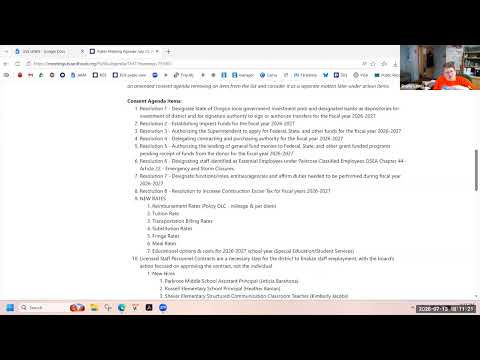
Sherry Lewis, the district’s chief financial officer, presented a consolidated consent agenda at the Parkrose Board of Education’s July 13 organizational meeting, outlining routine fiscal and administrative resolutions and a set of rate changes the board was later asked to approve by consent.
Lewis told the board the district will maintain accounts in the State of Oregon Local Government Investment Pool (LGIP) and use U.S. Bank as its primary checking depository for tax receipts and monthly payments. She said petty cash remains in limited use (primarily transportation reimbursements) and described a resolution designating the superintendent and CFO to apply for federal, state and private grants.
On contracting and interfund arrangements, Lewis said the board typically reviews contracts that exceed a threshold (described in discussion as roughly $250,000) and that a resolution authorizes temporary transfers between the general fund and program funds to meet matching or cash-flow requirements.
Lewis also described program-specific and rate items the board approved by consent: an annual construction excise tax rate to be submitted to the taxing authority (transcript language on the exact penny amounts and maximum is inconsistent), new internal and external transportation billing rates (internal rate cited as $38.20/hour; external billing $46.89/hour), and substitute-teacher pay calculated from the state base plus a district adjustment (one- to 10-day rate cited as $298.87; day 11 onward $382.80). She estimated roughly $1.5 million per year is spent on substitutes and explained most assignments are under 10 days.
Lewis reviewed fringe-rate recalculation and workers’ compensation increases, saying the district’s blended fringe rate recalculated to about 41.52% and that workers’ comp increases for groups such as bus drivers were a primary driver of the rise. She also gave examples of high-cost special-education placements (transcript examples included outplacements listed at roughly $99,200 to $191,000 per pupil, with transportation costs adding roughly $23,000–$25,000), and said the district projects special-education expenses will exceed the budget before the academic year begins.
Board members asked clarifying questions about the substitute and transportation rates, the frequency of long-term substitute assignments, and how the district vets contractors and community events referenced in other items. The board approved the consent agenda by voice vote; final ratification language (for example, the classified CBA wording tied to essential-employee designations) will come back when bargaining concludes.
Lewis was the primary source for the numbers in this report; where the meeting transcript contained inconsistent or unclear numeric phrasing (notably the construction excise tax wording), this article reports the CFO’s statements and flags the transcript ambiguity.