Get Full Government Meeting Transcripts, Videos, & Alerts Forever!
Get email alerts on the Humanitarian Aid topic
No spam. Unsubscribe anytime.
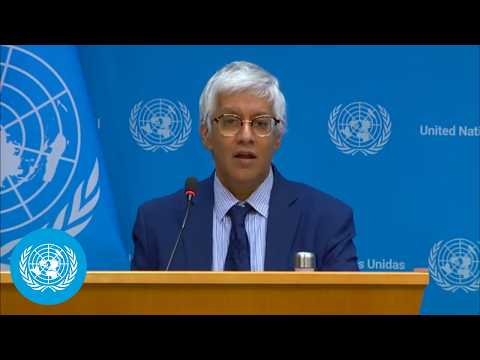
UN briefing outlines humanitarian needs in Gaza, Lebanon, DRC and Venezuela; major funding gaps noted
Summary
The UN spokesperson reported on multiple crises: water and waste challenges in Gaza, returns and displacement in Lebanon and the West Bank, a rising Ebola outbreak and attacks in eastern DRC, and a widened funding gap after earthquakes in Venezuela that leaves hundreds of millions unraised.
The United Nations press briefing provided a consolidated update on humanitarian situations across several regions, highlighting shortfalls in funding and ongoing operational constraints.
On the occupied Palestinian territory, the briefing reported that partners are delivering more than 17,000 cubic meters of drinking water daily via 2,460 distribution points but that deliveries are 15–20% lower than in June, a reduction the briefing attributed to funding shortages. The statement also said partners distribute over 4,600 cubic meters of domestic water per day for household needs and that waste-collection and pest-control efforts are under way; the briefing quoted partners as saying roughly 80% of solid waste is being collected and that about 80% of 3,500 identified pest hotspots have been reached.
The briefing said more than 741,000 people have returned to their communities in Lebanon since early March, but that more than 412,000 remain displaced and some 30,000 live in collective shelters. OCHA reiterated calls for protection of civilians and sustained humanitarian support.
In the Democratic Republic of the Congo, the UN’s humanitarian office reported an escalating violence picture that is hampering the Ebola response; the briefing cited 2,124 confirmed Ebola cases across multiple provinces and said transmission appears concentrated in Ituri province. The government provided 10 ambulances to bolster response operations.
Turning to Venezuela, UN humanitarian partners reported more than 100 aid organizations carrying out over 2,200 response activities and the coordination of over 525 metric tons of humanitarian supplies. The briefing restated the pre‑quake 2026 humanitarian plan (5,500,000 people at $632,000,000) and said nearly $300,000,000 in additional needs are required to assist 1,300,000 people affected by the earthquake, bringing the total requirements cited in the statement to $931,000,000; the briefing said less than 40% of that total has been received, leaving a gap of roughly $570,000,000.
The briefing emphasized that funding shortfalls are reducing service levels where needs are highest, particularly for water and cash assistance, and called for sustained international support. No new funding commitments or specific donor pledges were announced during the session.
The briefing did not provide a detailed breakdown of which donors or instruments would fill the gaps; many figures were presented as totals attributed to OCHA and partner agencies.