Get Full Government Meeting Transcripts, Videos, & Alerts Forever!
Get email alerts on the Cbc Ap Rfp topic
No spam. Unsubscribe anytime.
Children’s Cabinet details FY2026 CBCAP RFP, deadlines and budget rules
Summary
The Children’s Cabinet and KU CPPR walked applicants through the FY2026 Community-Based Child Abuse Prevention (CBCAP) RFP, explaining eligibility (birth–5 focus), the 10% cash-match requirement and a 10% cap on indirect costs, application deadlines and how to use the Kansas Common App platform.
Christy Wyckoff of the Children’s Cabinet opened a webinar for potential applicants to the federal Fiscal Year 2026 Community-Based Child Abuse Prevention (CBCAP) grant, outlining the program’s purpose, application process and timeline. “I oversee the CBCAP grant,” Wyckoff said, and introduced staff who will support applicants.
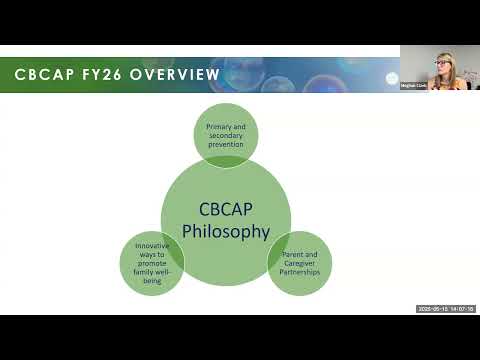
The nut graf: CBCAP is a federal formula grant under the Child Abuse Prevention and Treatment Act (CAPTA) intended to fund primary and secondary prevention for families with children birth to 5 and prenatal supports. The Children’s Cabinet is the state lead and will award community-based and statewide grants; community proposals must focus on prevention and may target underserved populations while statewide awards should serve the whole state.
Wyckoff and KU CPPR staff walked through the application requirements, budget rules and evaluation expectations. Key application rules reiterated by presenters include a required 10% cash match for CBCAP awards and a 10% cap on indirect costs. “There is a 10% cash match requirement,” Wyckoff said; she also explained that building-space and maintenance costs must be included in indirects rather than as a direct line item. Presenters instructed applicants to use the required Excel budget template, provide a justification for every CBCAP expense line, and list one funded person per personnel line.
Clayton Girard of KU CPPR demonstrated the Kansas Common App grant platform, showing how to start the CBCAP FY2026 application, navigate conditional questions and upload required templates. He emphasized operational details applicants commonly ask about: “Only one account can be working on the application for your organization,” Girard said, and advised teams to draft answers offline and save often.
During the question-and-answer portion, an attendee asked whether occupancy costs moved into indirects are included in the 10% cap; Wyckoff confirmed occupancy and overhead communications (phone and Internet) should be treated as indirects and thus subject to the cap. Presenters clarified that equipment necessary for staff to perform their duties, such as cell phones or laptops used by individual staff members in the field, can still be allowable when clearly tied to direct service delivery.
Presenters also highlighted evaluation and partnership requirements: applicants must include a logic model aligning proposed activities to CBCAP outcomes and upload partner-assurance templates for each funded or non-funded partner, describing roles and whether a partner would receive subawards. KU CPPR will provide technical assistance and evaluation support using tools cited in the RFP (for example PFS-2 and DAISY) and will be available via the TA form linked on the RFP page.
Important dates announced in the webinar: the deadline to submit questions through the TA form is Monday, June 16; applications are due Monday, June 23 at 05:00; and the review period runs June 24 through July 31, with a slate of recommendations presented to the Children’s Cabinet on August 1. Wyckoff cautioned that all recommendations are contingent on the actual federal award amount, which the state typically receives in mid-to-late September and which depends on the federal budget.
Several procedural clarifications were made on the record: federal funds and federal in-kind contributions cannot be used as match; the application includes online validation checks (applicants should resolve validation messages on the total budget tab to ensure compliance); and where guidance was unclear—specifically whether indirect costs can be counted as cash match—staff said they will follow up and publish a standard FAQ on the Cabinet’s RFP page.
The webinar recording and all RFP documents (budget template, logic-model template, partner-assurance template and application outline) will be posted to the Children’s Cabinet RFP web page. Presenters encouraged applicants to file TA requests through the form for detailed or account-specific assistance.