Get Full Government Meeting Transcripts, Videos, & Alerts Forever!
Get email alerts on the Oyster Reef Restoration topic
No spam. Unsubscribe anytime.
Staff describes limestone reef planting off Wrightsville Beach to grow hand-harvest oysters
Summary
Staff described a reef-planting operation off Wrightsville Beach using marl limestone deployed from two barges to create habitat for oysters that could be hand harvested within about three years; the program has planted roughly 30–40 acres annually in recent years.
Staff members described a limestone-based oyster reef-planting operation off Wrightsville Beach designed to grow oysters suitable for hand harvest.
“We're planting, to create an oyster habitat that can be hand harvested,” a staff member said, describing how crews place marl limestone and later overplant with shell to encourage larval attachment.
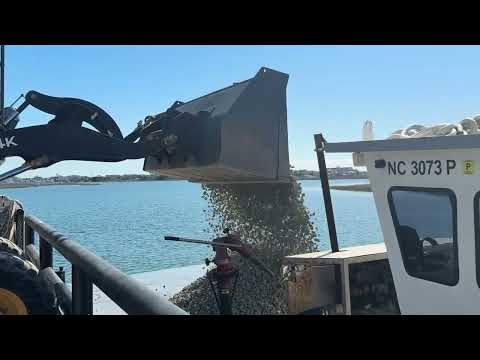
The program uses two barges, the Oyster Creek and the Cape Fear, to move and deploy material. “We have our smaller barge over here, the Cape Fear, that's delivering material to a shallower area that the Oyster Creek can't navigate through,” the staff member said, adding that the Oyster Creek can carry about 150 tons of material. A front loader transfers marl from a stockpile to a barge deck and crews use a high-pressure hose to spray the limestone into the water to form a reef.
Presenter commentary explained why limestone is used: ideal reefs would be built from oyster shell, but shell supplies have been limited in recent decades. The transcript notes crews spread a thin layer of marl limestone across sites of about 1 to 2 acres and plan to return to overplant and sprinkle shell.
Staff also described the program's scale: in the last four to five years the program has planted about 30 to 40 acres of what the transcript calls “coach reefs” each year. According to presenters, artificial reefs aim to reduce harvest pressure on wild oysters and provide habitat that attracts fish such as flounder and sheepshead while serving as nursery areas for species like gag grouper and black sea bass.
“Oysters are...ecosystem engineers. They filter the water, improve water quality,” a presenter said, noting reefs also help with shoreline erosion. The presenters estimated that, depending on salinity and water flow, sites like the one described could produce a substantial amount of legal-sized oysters suitable for hand harvest within about three years.
No formal actions, votes or regulatory citations were recorded in the transcript. The crew described operational steps and near-term follow-up work, including an immediate return to overplant and add shell to the site.
Next steps indicated in the presentation were routine: crews will return to the 1–2 acre site to add shell and continue monitoring growth; no regulatory decision or permit discussion was recorded in the transcript.