Get Full Government Meeting Transcripts, Videos, & Alerts Forever!
Get email alerts on the Water Quality Pfas topic
No spam. Unsubscribe anytime.
Committee hears utility update as PFAS levels creep near recommended threshold; SCADA online, hydrant flushing ongoing
Summary
Village staff reported PFAS testing showing some wells around 4–5 parts per trillion and outlined plans for treatment-plant design and funding; utility staff also described a months-long hydrant-flushing program (roughly 12 million gallons last full year) and said the SCADA control system is now online.
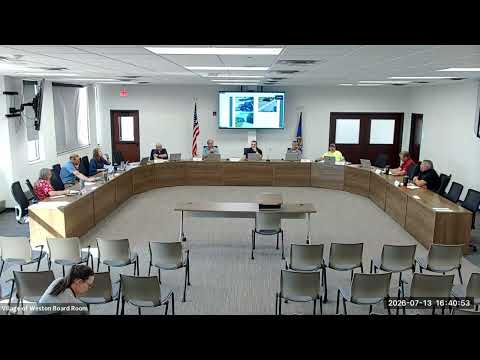
Michael, a village staff member responsible for capital and utility projects, told the Public Works & Utility Committee on July 13 that two wells — Bridal and Alta Verde — are “creeping up into that kinda 4 to 5 parts per trillion mark,” and urged planning for a treatment plant to address emerging PFAS limits. He cited the Environmental Protection Agency’s recommended level of about 4 parts per trillion as the context for the discussion and said staff will investigate funding options such as safe-drinking-water loans.
Josh, the village utility operator, described operations and maintenance issues that underlie the longer-term planning. “I think last year was 12,000,000 gallons,” he said when asked how much water was flushed during the village’s unidirectional hydrant-flushing program; a prior year, he estimated, was about 15,000,000 gallons. Josh explained the program is methodical — crews run hydrants until turbidity field tests reach acceptable NTU values before moving to the next section — and that a full village program can take “about 10 to 12 weeks.”
Josh also reported that the village’s SCADA (Supervisory Control and Data Acquisition) system is now online and providing remote visibility of wells, pumps and alarms. “It is nice to just see the overall footprint of the village with all of our wells and their stations and what’s going on in real time,” he said, and added staff have compiled a wish list of additional features staff would like the system to support.
Staff also raised a short-term staffing issue: one utility operator intends to leave, reducing the operator crew from five to four until a replacement is hired. Michael said a job advertisement will be posted shortly.
What happens next: staff said they will develop a design scope and budget estimate for PFAS treatment work and explore potential state and federal funding programs during the coming budget cycle; the committee asked staff to bring budget ballpark figures and possible grant sources to a future meeting.