Get Full Government Meeting Transcripts, Videos, & Alerts Forever!
Get email alerts on the Historic Preservation topic
No spam. Unsubscribe anytime.
College Place commission workshops historic-preservation chapter; planner says grant funds to advance National Register nomination are imminent
Summary
At a July 16 workshop the College Place Historic Preservation Commission reviewed the draft historic preservation chapter, agreed to ask consultants to include property photos, recommended language changes to better frame the commission’s role, and heard from Senior Planner Michael Merritt that federal grant money to support a district National Register nomination is expected to be awarded to the city shortly.
College Place — The College Place Historic Preservation Commission on July 16 reviewed the draft historic preservation chapter of the city’s comprehensive plan and directed staff to pass commission edits to the plan consultant, Senior Planner Michael Merritt said.
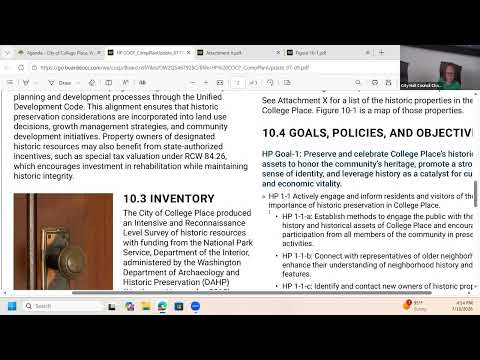
Merritt led commissioners through the introduction, inventory and the goals-and-policies section and asked for targeted wordsmithing and factual corrections. "I will take our notes here and take them back to our consultant team," Merritt said, outlining that the full package will go to a city council workshop next month and then to the planning commission for recommendation ahead of final council adoption.
Commissioners flagged several factual items for correction in the reconnaissance-level inventory: an address listing for "201 Southwest Bade" and an entry with a circa-1900 date that several members said looked inaccurate. Merritt said those entries derive from a 2019 reconnaissance survey and offered to investigate and update the consultant's material.
The commission debated wording in policy HP 1.1 about public involvement. One commissioner urged language that emphasizes the commission’s supportive role rather than a controlling one, arguing property owners sometimes view the HPC as burdensome. "We're here to help facilitate or to help you receive those tax incentives, but not to make your job harder," the chair said, recommending edits that stress collaboration. Merritt agreed to pass suggested phrasing to the consultant team.
Members also discussed demolition policy language that would allow demolition only when "there are no other options" and require mitigating measures if demolition is unavoidable. When asked what mitigation might mean in practice, Merritt said it could include pre-demolition documentation such as a survey or photographs and confirmed that a demolition permit is required.
Commissioners supported including property photographs with the inventory, noting photographs would aid identification and public outreach. Merritt said the reconnaissance-level report already includes photo pages (56–62) and that he would advise the consultant to incorporate photos into the attachment list.
On funding and the National Register effort, Merritt told the commission that federal funds tied to the city's Certified Local Government (CLG) grant —a project to advance a district nomination for the Wall Wall University area—had been delayed but were recently released to the administering body. "They are now in possession of the money, and they will be awarding it to us shortly," Merritt said, adding the city will then seek a consultant to move the district nomination forward if the award is finalized.
Commissioners raised several other inventory questions (building names, address assignments and suspected construction dates) and offered to send corrections and details to Merritt so he could reconcile them against the reconnaissance-level survey. Merritt noted that addressing is managed by the county in some cases and that boundary checks will be needed to confirm whether certain properties lie inside city limits.
The commission concluded with a brief note on ongoing work at the local Chrysler dealership property (a remodel with building permits in progress) and adjourned at 4:44 p.m. The commission set its next regular meeting for Oct. 15.
Votes at a glance: The meeting approved the consent agenda (the July 16 agenda and the minutes from Feb. 19, 2026) by voice vote following a motion and second; the chair announced the ayes and the motion carried.