Get Full Government Meeting Transcripts, Videos, & Alerts Forever!
Get email alerts on the Local History topic
No spam. Unsubscribe anytime.
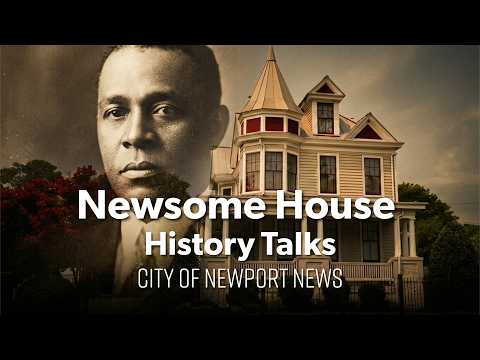
Newsom House program highlights Joseph T. Newsom’s role as lawyer and community organizer
Summary
At a public program at the Newsom House Museum and Cultural Center in Newport News, museum staff traced Joseph T. Newsom’s life and the house’s role as a hub for Black civic life; descendants and board members shared personal memories and the museum outlined archives and tour hours.
Patricia Taylor, a member of the Newsom House Foundation board, opened a public program at the Newsom House Museum and Cultural Center in Newport News and introduced museum staff and community descendants who spoke about the site’s history.
Tad Williams, who identified himself as staff at the Newsom House, led a history presentation that described Joseph Thomas Newsom as “one of the most prominent black lawyers from Newport News in the early 19 hundreds” and said the home served as “a hub for activism for the community.” Williams said Newsom was born in Sussex County in 1869, attended Virginia Normal (now Virginia State University) and Howard Law, and later practiced in Newport News, where he focused on civil rights, voting-rights cases and mentoring younger Black lawyers.
The museum talk emphasized the house’s architectural and social history. Williams described Queen Anne–style alterations, original hardwood floors and early electric lighting still present in the house, and said the Newsoms added features such as a wraparound porch, a turret and a second-floor bathroom. He also said the household hosted prominent visitors and community organizing, noting that discussions in the home contributed to the founding of Huntington High School and supported businesses on Chestnut Avenue.
Williams credited community preservation work led by Carrie Brown, who bought and restored the property and neighboring houses after they had fallen vacant; he said the restoration involved roughly $600,000 in fundraising and that the Newsom House Foundation board was created in 1991 to sustain the site. Williams said the museum now offers regular public tours and programming and that many archival materials are being digitized, including Huntington yearbooks covering roughly 1924–1970 that the museum is making available to the community.
Patricia Taylor and other speakers framed the program as a chance to pass local memories and norms to younger generations. Taylor described the neighborhood as once tightly knit—"everybody's one child was everybody's child"—and contrasted that with modern concerns about community cohesion.
Brenda Tucker, introduced at the event as a descendant of the Tucker family, gave extended recollections of growing up on 39th Street (now Pembroke Avenue), describing her family’s produce business, neighborhood routines, and the role of schools and churches. Tucker also described a recent trip to Angola where she visited an orphanage and observed ongoing poverty; she said the visitors brought small donations and spoke of the need to preserve and teach local and global histories.
The museum presentation highlighted three immediate, tangible resources: regular tours (Williams said the museum gives full tours Fridays and Saturdays, 10 a.m. to 4 p.m.), an active foundation board overseeing programming, and an archive project digitizing local yearbooks and donated documents. Organizers encouraged attendees to consult the museum’s archives and to contact the foundation for group visits.
The program preserved first-person memories about daily life on Chestnut Avenue, local institutions such as Booker T. Washington Elementary School and Huntington High School, and how community members used the house as a civic and social hub. The museum’s materials and ongoing digitization, organizers said, aim to make those materials available to researchers, students and neighborhood residents.
Note on names and spelling: the event and the transcript use variant spellings (e.g., "Newsom," "Newsome," "Newson") and multiple personal introductions; this article follows the museum’s usage and standardizes the family name as "Newsom" and attributes remarks to the speakers as introduced at the program (Patricia Taylor, Tad Williams, Brenda Tucker, Cassandra Wright).