Get Full Government Meeting Transcripts, Videos, & Alerts Forever!
Get email alerts on the Drones Fleet Zoning topic
No spam. Unsubscribe anytime.
Mesa council weighs zoning rules for drone docking and fleet charging as new state law looms
Summary
Mesa staff proposed text amendments that classify 'fleet based services' (light, heavy, accessory) and set development standards for drone docking/charging. Council debated setbacks, 30‑foot pole heights, CUP requirements and whether to require ground landing ahead of House Bill 2875 taking effect.
Mesa’s City Council spent the bulk of its July 16 study session debating how the city should regulate docking and charging stations for drones and other new fleet services as state law limiting local control takes effect in September.
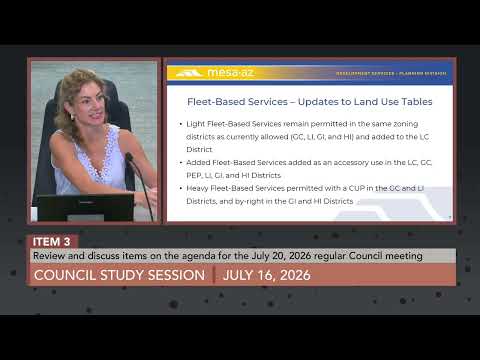
Planning staff told council they have drafted text amendments that create a single ‘‘fleet based services’’ category with subcategories for light, heavy and accessory operations, and that the amendments would apply existing land‑use rules to drone delivery docking and vehicle charging. Staff said light fleet services would generally fit in existing commercial districts, while heavy fleet services (over 50 vehicles, vehicles over 10,000 pounds or more than 10,000 square feet of staging) should require a council use permit so impacts on nearby residences can be reviewed.
“I'm concerned about what I would call the beehive effect where our neighborhoods now hear nonstop humming of drones above their heads,” Councilmember Taylor said, urging larger setbacks and stronger aesthetic protections. Taylor asked whether the city can set hours of operation and require setbacks greater than the draft 100 feet.
City attorney’s office counsel Kirsten DeBorchak briefed council on the new statute (House Bill 2875), saying the state preempts many aspects of drone operation but allows cities to regulate land use and, in some cases, docking within 150 feet of residential zones. “We are able to regulate landing and docking if they’re within a residential district or within 150 feet of a residential district,” DeBorchak said.
Planning staff showed examples of pole‑mounted docks and ground pads. Staff recommended treating roof‑mounted, pole‑mounted and ground docking consistently and proposed a 30‑foot maximum pole height to align with base zoning height limits. They also recommended a 100‑foot separation for electric charging equipment with a waiver process allowing the planning director to reduce that distance if a sound study demonstrates no increase in ambient noise.
Several council members favored increasing setbacks to 150 feet to match the statute. Others argued pole‑mounted docking uses land more efficiently and could be allowed in industrial districts or subject to a council use permit in commercial districts. Councilmember Duff said she prefers poles because they “double use the land” and can support other uses underneath; Councilmember Adams argued for ground landing only.
Staff emphasized Prop 207/property‑rights constraints that limit the city’s ability to remove existing permitted uses, so any change to existing rights should be approached carefully. Several council members asked staff to bring ordinance language back quickly so the city can adopt its standards before the state law takes effect.
The council provided direction to staff to refine the draft: to consider a 150‑foot residential separation consistent with the statute, limit pole heights to the applicable zoning height (30 feet in many districts), plan for CUPs for heavier operations, and add a waiver process based on sound studies. Staff said they will return with revised language for introduction at the next council meeting.
The discussion did not include a formal vote to adopt ordinance language; council gave staff direction to draft and introduce amendments for council consideration.
Mesa’s planning staff and city attorney said the changes would apply both to aerial docking infrastructure and related electrical charging equipment and that the planning director would retain discretion to grant exceptions when a technical study supports it.