Get Full Government Meeting Transcripts, Videos, & Alerts Forever!
Get email alerts on the Boating Infrastructure Grants topic
No spam. Unsubscribe anytime.
Division of Coastal Management details FY2027 Boating Infrastructure Grant rules, deadline Aug. 28
Summary
The Division of Coastal Management hosted an applicant webinar outlining FY2027 Boating Infrastructure Grant eligibility, funding tiers (tier 1 up to $300,000; tier 2 up to $1.5 million), the required 25% nonfederal cash match, calculation rules and a submission deadline of 5 p.m. Eastern on Aug. 28, 2026.
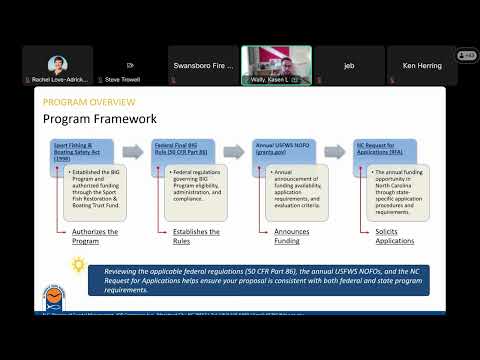
The North Carolina Division of Coastal Management (DCM) hosted an FY2027 Boating Infrastructure Grant (BIG) applicant webinar that reviewed program goals, eligible projects, application components and post‑award responsibilities, and set the application deadline for 5 p.m. Eastern on Aug. 28, 2026. "Applications are due to the Division of Coastal Management no later than 5PM eastern time on 08/28/2026," said Kayson Walley, BIG program coordinator.
Why it matters: BIG provides federal funding for construction, renovation and maintenance of publicly accessible boating infrastructure that serves transient recreational vessels. Applicants can request up to $300,000 under tier 1 (competing within North Carolina) or up to $1.5 million under tier 2 (competing nationally); each state may submit only one tier 2 application to the U.S. Fish and Wildlife Service (USFWS). Successful awards require a minimum nonfederal cash match of 25 percent, and North Carolina requires that match be nonfederal cash rather than in‑kind contributions.
DCM staff summarized what counts as eligible work and what does not. Eligible activities include docking infrastructure (transient slips, day docks, floating docks and mooring buoys), supporting amenities such as fuel stations and pump‑out facilities, navigation and safety improvements, planning and engineering, permitting and environmental studies, and shoreline stabilization. Walley also warned that typical operating costs — salaries, utilities, insurance, routine maintenance, and buildings not directly serving transient vessels — are generally ineligible. He noted that, while federal rules allow dredging, DCM has made a state policy decision not to fund dredging projects in North Carolina so limited funding is concentrated on long‑term public access and infrastructure improvements.
The webinar covered application mechanics and reviewer expectations. Applicants must submit a single electronic package (email to ncbig@deq.nc.gov if under 20 MB or upload to DCM’s share file and notify staff). Required components include a signed title page, a 3–4 page project summary worksheet, a project narrative (10‑page limit), maps/drawings (20 pages), a budget narrative (no page limit) and supporting documents (20 pages). Walley emphasized consistent documentation, verifying calculations, and following formatting requirements.
DCM walked through budgeting and proration rules. When projects serve both eligible transient vessels and other users, applicants must prorate costs to reimburse only the portion that benefits eligible users. In a sample calculation, a $1,000,000 project adding 200 slips with 35 designated for eligible transient vessels produced an eligible share of 17.5 percent and a federal request of $135,250 after the 25 percent match. Applicants must calculate percentages to four decimal places and round dollar amounts to the nearest dollar.
Review and post‑award process: DCM will evaluate and rank applications using federal criteria in 50 CFR part 86 and the USFWS NOFO, augmented by North Carolina‑specific criteria (for example, additional points for North Carolina Clean Marina participation and for extra cash match). DCM will submit recommended tier 1 and the highest‑ranked eligible tier 2 application to USFWS for federal review. Walley cautioned that a USFWS referral or notice of award does not authorize construction; recipients must complete federal and state pre‑award compliance (environmental reviews, permits and other conditions) before funds can be obligated and a subrecipient agreement executed by the Department of Environmental Quality. The typical timeframe includes up to three years to complete pre‑obligation tasks and a period of performance that is generally three years, with extensions possible but discretionary.
Questions and follow‑ups: During the Q&A, participants asked whether the state will provide examples of past successful submissions; Rachel Levadrick, planning and resilience section chief, said DCM will contact Marine Fisheries and USFWS to request sample submissions and testimonial material. A participant asked for clarification on tier 2 submissions; Walley confirmed that North Carolina may submit only one tier 2 project to USFWS and that DCM will internally rank multiple eligible tier 2 applicants and forward its top selection. For procedural questions DCM advised applicants to contact the program at ncbig@deq.nc.gov or use the contact information on the BIG program website.
The webinar recording, slide deck and additional guidance will be posted on the program website, and DCM said it will email attendees with follow‑up answers and milestones as federal timelines become available.