Get Full Government Meeting Transcripts, Videos, & Alerts Forever!
Get email alerts on the County Finance topic
No spam. Unsubscribe anytime.
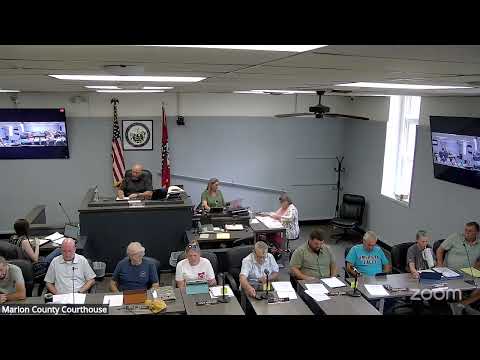
Marion County court approves multiple appropriations and grants; objects 6–3 to discussion of a contested ordinance
Summary
At its July 14 meeting Marion County justices approved several appropriations and transfers including auction proceeds ($6,360), a court security grant (recorded as $18,006,699.99), re‑striping funds ($26,584.02), a $900 election stipend appropriation and a jury reimbursement ($1,101,112.89); a subsequent objection to consideration of a contested ordinance passed 6–3, postponing discussion.
Marion County justices approved a series of financial ordinances and appropriations at their July 14, 2026 session and, after a point of order, voted 6–3 to object to consideration of a contested ordinance that a justice described as "unconstitutional."
The clerk introduced Appropriation Ordinance 26‑33 to appropriate $6,360 in proceeds from the sale of retired county road vehicles into the sales tax road fund; the court moved, seconded and recorded affirmative votes to approve the item.
Clerk read Ordinance 26‑34 as a grant from the Arkansas Administrative Office of the Courts "for court security" for Marion County in the amount recorded in the meeting as $18,006,699.99 to be appropriated for security cameras, door locks/release systems, courtroom devices and rear entry security. The court moved, seconded and approved the appropriation by voice vote.
Ordinance 26‑35 was introduced to transfer $26,584.02 for re‑striping county roads; the court approved the transfer after motion and second. The clerk also reported receipt of $900 from the state board of election commissions as stipends for the election commission; the clerk said those funds would be appropriated to part‑time help and the item was approved.
The clerk reported a state reimbursement of $1,101,112.89 for jury costs for the first quarter of 2026; the funds were appropriated to jury per diem and the ordinance was approved.
Later in the meeting a justice raised a point of order and said an attorney opinion and the justice's own counsel had advised the contested ordinance was unconstitutional and that it had been turned down by the budget committee. The presiding justice explained voting semantics for the objection motion: "A yes vote means you are objecting it. You do not want to discuss it... A no vote means you do not want to object this. You want to discuss it tonight," and then called the vote. The clerk announced the tallied result: "Yes is 6. No is 3." The court recorded the motion as passed, and the contested ordinance was not discussed that night.
The court then adjourned.