Get Full Government Meeting Transcripts, Videos, & Alerts Forever!
Get email alerts on the Redevelopment Projects topic
No spam. Unsubscribe anytime.
Redevelopment Authority of Green Bay approves multiple TID actions, funding commitments and contract awards
Summary
At its meeting the Redevelopment Authority of Green Bay approved an allocation amendment and termination resolution for TID 12, established/approved project plans for three new TIDs, authorized an affordable housing extension, and approved a package of contracts and funding—including $800,000 for a neighborhood roadway, a $374,000 greenway contract, and Phase 1 naming-rights work.
The Redevelopment Authority of Green Bay on Thursday approved a package of redevelopment actions that included reallocating tax increments, creating three tax-increment districts (TIDs) and committing city funding and contracts to multiple housing and infrastructure projects.
Rebecca (staff member) opened the meeting and described four public hearings. She said the first action would reallocate up to $1,400,000 from TID 12 (I‑43 Industrial Park) to TID 22 (Shipyard) to support eligible project costs and Shipyard Park Phase 2 public improvements, and clarified that the reallocation is separate from a previously approved one‑year affordable‑housing extension for TID 12. After discussion, the authority voted to approve the allocation amendment and then approved a termination resolution setting TID 12’s termination date to 08/18/2026 to comply with statutory sequencing for joint review board and council review.
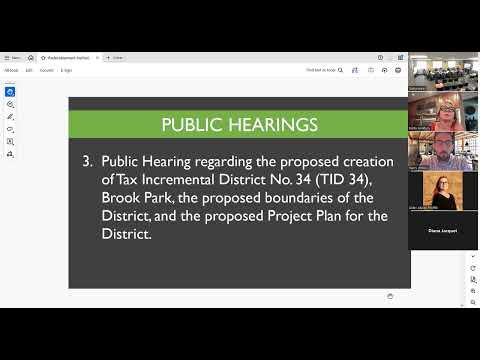
Consultant Harry Allen (Ehlers) presented three proposed blighted‑area districts and associated project plans. For the proposed TID 33 (Belth Avenue corridor), Allen said the plan targets a 90‑unit multifamily infill project on Parcel 23, would be designated a 27‑year blighted district and is expected to generate about $12.2 million in new equalized value; the plan includes a $2.0 million pay‑as‑you‑go developer incentive. On TID 34 (Brook Park), staff described a Tycor Build proposal for roughly 155 residential units and mixed uses on ~123 acres, with projected equalized value of about $57.8 million and an estimated PAYGo request just over $11.0 million; staff warned boundaries may need adjustment to meet statutory mixed‑use and newly‑platted residential percentage tests. For TID 35 (200 North Monroe, “Monroe Residences”), staff described a multi‑phase proposal for 140 multifamily units, 28 townhomes and ~4,500 square feet of commercial space supported by a 5% PAYGo with a $6.3 million cap and projected increment collections of roughly $10.1 million over the district’s 27‑year life. The authority voted to establish TID 33 and to approve the project plans for TIDs 34 and 35, with staff noting possible minor boundary amendments before final council action.
The board also approved a one‑year affordable‑housing extension for TID 5 (East and West downtown). Staff said statute allows a one‑year extension when at least 75% of the final year’s increment is directed to affordable housing; staff estimated approximately $2.1 million would be transferred into the housing fund under the extension.
Separately, the authority approved several financing and contract actions: up to $800,000 of TIP 10 funds were authorized to help build a road connecting Imperial Lane to the JBS neighborhood and to support related park improvements, with staff adding that if wetlands block the vehicle connection the funds could be used for parking improvements instead. The board granted a 180‑day planning option extension for Green Bay Real Estate Investments LLC to continue design work on a 1.83‑acre Main Street site (1531 Main Street) where a ~30‑unit market‑rate rental project is proposed.
On facilities and contracts, the authority approved Phase 1 (due‑diligence) work with a naming‑rights consultant, authorizing a $50,000 Phase‑1 engagement to identify naming‑rights value and options for the Green Bay Convention and Conference Center (formerly the KI Center); staff said Phase 2 would be optional and could include a retainer and a commission on any agreements procured. The board consented to an assignment of the convention center operator agreement in connection with the sale of the hotel to Riviera Hospitality Green Bay, LLC and approved a developer agreement with NeighborWorks Green Bay for a six‑unit townhome project (four units to be held in a community land trust), noting a construction funding gap of about $275,000 for which NeighborWorks intends to apply for gap funds.
Public Works staff recommended awarding a contract to Northeast Asphalt for Badger Greenway site improvements ($374,000) funded largely with ARPA green‑infrastructure dollars and an EPA brownfields grant. The authority also approved a 12‑month contract extension for administration of the home‑improvement loan program to bridge uncompleted work under the expiring contract. Finally, the board approved the 2026 annual action plan for the Community Development Block Grant and HOME programs, forwarding the plan to city council; the plan includes a CDBG allocation of about $941,462, $94,000 for public services, $328,000 for infrastructure/park improvements, a $50,000 pilot microenterprise grant program, and $200,000 for the economic development revolving loan fund.
Quotes and sources: Harry Allen (Ehlers) explained the developer incentives and long‑term revenue expectations for the proposed districts; Rebecca (staff member) outlined the statutory sequencing for joint review board, RDA and council action; a staff presenter said the naming‑rights Phase‑1 engagement would cost $50,000 and Phase‑2 would be commissioned if the authority chose to proceed. The meeting adjourned following routine project updates and announcements.
What happens next: Several items will proceed to the city council for additional approvals (including the TID terminations and project plans) and staff will return with any required boundary amendments and joint review board actions to satisfy statutory timelines.