Renton planners brief council committee on long‑range plan, Valley development and state‑mandated code changes
Summary
Planning staff told the council committee the city’s comprehensive-plan update is fully certified by PSRC and the State Department of Commerce, outlined a 12–18 month Valley community‑plan process tied to major private investments, and reviewed state-mandated code changes affecting housing, ADUs, parking and neighborhood retail.
Planning staff presented a long‑range plan update to the Renton City Council committee, saying the city’s recently adopted comprehensive plan has been fully certified by the Puget Sound Regional Council and found compliant by the Washington State Department of Commerce, a status staff said matters for grant eligibility.
“We are in full compliance,” said Angie Matias, the staff presenter, adding that the city completed the comprehensive‑plan transportation element and state certification steps that influence eligibility for funding. The presentation summarized work since the Dec. 2025 adoption and noted related code updates completed in 2025 and 2026.
Why it matters: PSRC’s Vision 2050 framework frames Renton’s city center as a regional growth center with roughly 17,000 jobs, about 606 acres and an estimated 4,000–5,000 residents in the center. Staff said PSRC asked the city to document the growth‑center boundary’s rationale as part of periodic recertification.
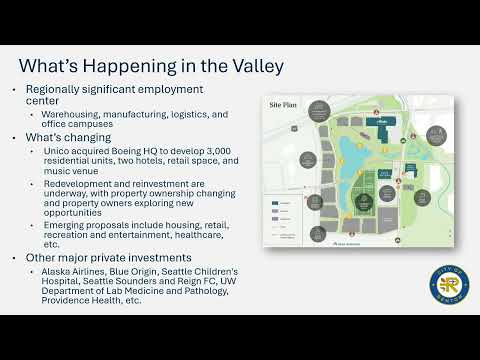
Staff outlined a priority: completing a Valley community plan to guide a swath of largely industrial land that has seen recent private‑sector interest. “Property owners want to develop it with 3,000 residential units, at least two hotels, retail space, and a music venue,” Matias said, describing a phased master‑planning approach with a private partner. The Valley plan, she said, will be a roughly 12–18 month process led by city staff with consultant support and an advisory committee; the city is about six months into that work.
Matias highlighted recent private investments changing the local economy: Alaska Airlines’ headquarters in Renton, Blue Origin’s engineering and industrial operations (which Matias said employ more than 2,000 locally), Seattle Children’s acquisition of more than 40 acres in the Valley and Providence Health’s expansion. She described wetlands, Springbrook Creek and constrained east‑west vehicle access as central planning considerations for the Valley.
State‑mandated code changes were a major focus. Staff reviewed: local project review updates completed in 2024 to harmonize permit timetables across jurisdictions; middle‑housing requirements that allow duplexes, triplexes, fourplexes, townhomes, stacked flats and courtyard apartments; and ADU reforms. On ADUs, Matias said the city must allow up to two attached or detached ADUs per lot, remove owner‑occupancy requirements, and accommodate ADUs up to about 1,000 square feet and roughly 24 feet in height.
The city also reviewed conversion‑to‑housing rules that permit residential conversion of commercial buildings with up to a 50% density increase if the work stays within the existing building envelope, and explained co‑living rules (shared‑household models) and how the state counts density for those projects.
Parking reform drew questions from council members. Matias summarized the new limits: “We can only require 0.5 a space per multifamily unit regardless of bedroom count,” she said, and a single‑family unit may be required to provide one parking space. She acknowledged a concern that transportation improvements often lag development planning and said advancing transit remains critical to the policy’s intent.
Neighborhood retail was another highlighted code amendment. Staff said a public survey showed roughly 70% support for small‑scale retail in residential areas; the draft code would permit businesses such as small markets, cafes, barbers and small offices on corner lots or within 0.25 mile of major transit stops, limit maximum size to about 1,800 square feet (with a modification process) and restrict hours to roughly 7 a.m.–9 p.m.
On housing funding, staff said the city has secured infrastructure grant funding through the state’s CHIP program and cited a $1,000,000 award toward Willowcrest townhomes, with plans to apply again for Vision House and Steel House infrastructure funding. Staff also reported recent rezones to align multifamily projects with RMF2 density standards and noted two current comp‑plan map amendment requests.
Next steps: staff said the Valley plan will advance with city‑led outreach and advisory‑committee review and is expected to return to the council for adoption consideration next year, though the process could extend into the following year. Council members asked for explicit outreach to the Equity Commission and for archival notes explaining unusual growth‑center boundary choices; staff agreed to follow up by email.
The committee closed after brief Q&A and thanks to staff for the presentation.
AI generated
The text on this page is AI generated. Summaries, highlights, analysis, and video transcripts are all produced from the original source material.
AI can make mistakes, so if you spot one, and we will fix it for everyone.
Note: the source content is unaltered by us. Any content source we link to, be it a video, an audio recording, or a document, is presented exactly as its publisher released it. That publisher is usually a government body, sometimes an individual official or another organisation.