Get Full Government Meeting Transcripts, Videos, & Alerts Forever!
Get email alerts on the School Site Remediation topic
No spam. Unsubscribe anytime.
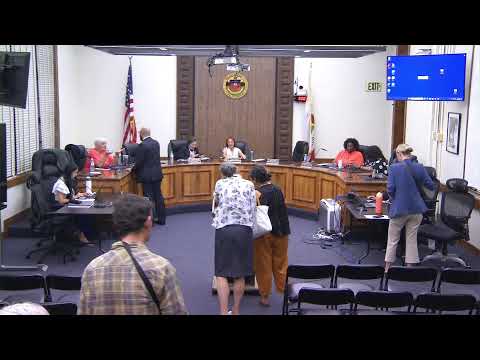
Pasadena Unified board authorizes jurisdictional resolution amid community pleas to save mature trees
Summary
The Pasadena Unified board voted 4''to''2 to approve a resolution clarifying the district's authority under Section 53097 to direct remediation on school properties, saying student safety and regulatory compliance require action while the community pushed for alternatives to cutting mature trees.
The Pasadena Unified School District board voted to approve a resolution authorizing the district to act under Section 53097 for school properties, a jurisdictional clarification staff said is necessary to proceed with lead and arsenic remediation at multiple campuses.
The resolution passed 4''to''2 after more than an hour of public comment in which residents, teachers and local group leaders urged the district to seek alternatives that would preserve mature trees while remediating contaminated soil.
The vote, recorded in the transcript, listed Scott Harden voting no; Kimberly Kenny, Michelle Richardson Bailey, Beatrice Marshall Mackenzie and Yarma Velzquez voting yes; and Tina Fredericks voting no. The motion was announced as carried.
Why it matters: district staff and board members said schools must meet higher remediation standards because children spend sustained time on campuses, and the district faces a narrow summer window to complete excavation and replacement work without exposing students. Opponents said mature trees provide air-quality, mental-health and community benefits and pressed the district for less-destructive alternatives.
Community pleas and alternatives
Multiple speakers during the public-comment period urged the board to pause or modify plans to remove mature trees. Lisa Quinn, who identified herself as a teacher in Pasadena, told trustees: "Les recomendareda fuertemente a la mesa directiva que busquen otros me9todos ... para mantener a los rboles, en vez de eliminarlos mientras se remedia la tierra." Several other residents echoed that request and offered volunteer expertise to try less-invasive remediation methods.
Board and staff response
District staff described the remediation scope and regulatory constraints. The staff presentation said the district collected roughly 1,000 soil samples across campuses and identified impacted areas that require remediation to meet school-site standards enforced by the Department of Toxic Substances Control (DTSC). Staff noted that DTSC applies different remediation expectations on school properties than on parks or private residences because of children's exposure.
Staff described two primary approaches: full soil replacement to return sites to pre-contamination conditions and DTSC-approved in-place or engineered-cleaning methods that may limit disturbance. For some large trees the district is evaluating specialized methods (transcribed as "Air Nifing") that staff said could reduce tree removal but add costs; staff estimated an additional roughly $2,000,000 to use that alternative for 44 trees.
Costs, timing and funding
Staff told trustees the district had awarded a contract tied to the remediation project and that the work was first estimated at about $6,000,000 (staff later referenced $6.6 million) but that costs and scope are evolving; staff cited a current higher projection of about $10.7 million and additional excavation estimates of roughly $2.5 million for supplemental work. Staff said the district is negotiating insurance reimbursement but that reimbursements are not guaranteed and would be itemized by specific work.
On timing, staff emphasized a limited summer window to remove soil and return clean material before students return; several trustees and staff warned delays would push work into a future summer and could require long-term cordons that keep children away from portions of campus.
Contamination levels and testing
Staff said testing found elevated contaminant levels in some locations, citing examples in the presentation (for example, arsenic and lead readings transcribed at notably high levels at some sites). The district said it took more than 1,000 samples, identified about 11 campuses requiring additional remediation and estimated more than 8,000 cubic yards of impacted soil (the transcript also referenced "me1s de 23,000 libras" of soil in the same discussion). Staff cautioned that specific numeric descriptions in the public presentation reflected preliminary results and that DTSC must approve remedial methods.
Board framing and next steps
Dr. Velzquez, speaking for the board during deliberations, framed the resolution as a jurisdictional determination and stressed the board's primary responsibility to student safety: "Nuestra responsabilidad es asegurarnos que los estudiantes aprenden en escuelas que este1n seguras hoy y para las siguientes generaciones." She and other trustees said the board would pursue alternatives where possible but must ensure compliance with DTSC requirements and prudent use of public funds.
The district also said it would continue community outreach, share monitoring records and work with arborists and technical partners to explore preservation options where feasible. The board passed the resolution and directed staff to continue remediation planning under the district's authority; staff noted DTSC approval is required before some alternative methods could be used.
What happens next
Staff said they will continue to refine cost estimates, seek any available reimbursement and pursue DTSC approval for specific remediation approaches. The district also said it will provide updates to the community and continue consultations with arborists about tree preservation and replacement when removal is necessary.
Vote at a glance: resolution authorizing district action under Section 53097 on school properties
Outcome: Approved, motion passed 4-2. Yes: Kimberly Kenny; Michelle Richardson Bailey; Beatrice Marshall Mackenzie; Yarma Velzquez. No: Scott Harden; Tina Fredericks.
(Transcript-based reporting: all quotes and vote tallies come from the public meeting transcript.)