Get Full Government Meeting Transcripts, Videos, & Alerts Forever!
Get email alerts on the Living Shorelines topic
No spam. Unsubscribe anytime.
UNCW and Sea Grant experts promote living shorelines and oyster-reef restoration at Oak Island town hall
Summary
At an Oak Island town hall, UNCW and North Carolina Sea Grant scientists described living shorelines and oyster-reef restoration as alternatives to hardened bulkheads, outlined local demonstration projects and funding and answered questions about upkeep and permitting.
Oak Island — Scientists from the University of North Carolina Wilmington and North Carolina Sea Grant told a packed town-hall audience Tuesday that living shorelines and oyster-reef restoration can reduce erosion, improve water quality and support fisheries while offering alternatives to traditional bulkheads.
At the event, Troy Offen, a senior research associate at UNCW's Center for Marine Science, introduced presenters Dr. Mariko Polk, a coastal processes specialist affiliated with North Carolina Sea Grant and stationed at UNCW, and Dr. Martin Posey, a benthic ecologist at UNCW. Kent Jackson, the town's interim manager, opened the meeting.
Polk, who described Sea Grant’s outreach role and local public-safety work such as rip-current warnings, said living shorelines use plants and structural elements like offshore sills to dissipate wave energy and maintain a connection between marsh and water. "Living shorelines can actually reduce the amount of wave energy by 60%," Polk said, citing peer-reviewed work and North Carolina research. She noted that living shorelines also trap sediment and help marsh vegetation establish and grow.
Posey focused on oysters, explaining how historic overharvest, power dredges and disease caused major declines in oyster reefs. He said restored oyster reefs serve as habitat for fish and crustaceans and have important filtration and nutrient-removal functions; "single oysters can filter up to 50 gallons a day," Posey said, summarizing laboratory and field findings.
Both speakers attributed multiple benefits to reef-based shorelines: reduced erosion, enhanced marsh growth and improved water clarity that can mitigate algal blooms by removing nitrogen and phosphorus. Posey also cited regional studies that estimate economic returns from oyster restoration, saying roughly $1 invested can yield about $1.74 in ecosystem and fishery benefits (figure quoted from economic analyses discussed in the presentation).
Polk and Posey discussed barriers to wider adoption, including the prevalence of existing bulkheads, perceptions about durability in high-energy sites, gaps in contractor experience and permitting questions. Polk said North Carolina offers a special permit for living shorelines that can be as simple to obtain as a bulkhead permit, and she mentioned assistance programs such as cost-share from the North Carolina Coastal Federation and a CCAP program administered through soil and water offices to help homeowners with installation costs.
During a question-and-answer session, an attendee asked whether oyster-shell shorelines require extensive upkeep. Polk responded that maintenance — such as replanting marsh vegetation for one or two years — is often part of projects while they establish. She described experiments that use a stronger base (concrete or engineered substrate) covered by shell to reduce burial and the need for repeated maintenance. "Maintenance is, of course, a thing," Polk said, and Posey added that sites and sediment conditions affect how frequently work is needed.
Both presenters pointed to local demonstration and restoration sites — including Carolina Beach Park, Bradley Oaks, Airlie Gardens, Morris Landing Preserve and projects near Saint James — and encouraged residents to look at nearby installations to see how designs vary by site energy and shoreline form. They also emphasized the importance of shell recycling programs; Polk noted North Carolina law discourages discarding shell, so shells are collected for restoration projects.
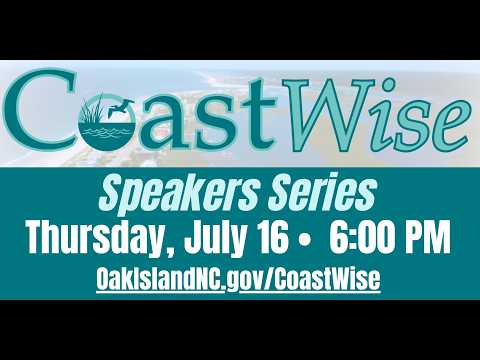
The program was presented under Oak Island Coastwise, a partnership between UNCW and Oak Island leadership; Polk and Posey encouraged audience members to ask questions and said UNCW would be involved in upcoming local projects. The evening closed with staff and presenters inviting further questions and follow-up after the session.
The town-hall did not record any formal motions or votes. Next steps discussed were informational: residents were directed to permit and cost-share resources and to local project sites for examples of living-shoreline installations.