Get Full Government Meeting Transcripts, Videos, & Alerts Forever!
Get email alerts on the Infrastructure Development topic
No spam. Unsubscribe anytime.
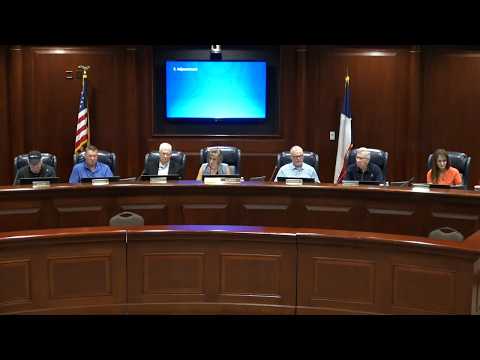
After heavy public comment, Granbury Planning & Zoning Commission backs citizen‑draft limits on data centers and power plants
Summary
Following hours of public comment and technical questions, the commission voted 6–0 on July 13 to recommend a citizen‑draft amendment to Zoning Ordinance Article 4 that would require special‑use permits and a 1,000‑foot setback for data centers and power generation, sending the draft to City Council.
The Granbury Planning & Zoning Commission on July 13 unanimously recommended that City Council consider a citizen‑draft amendment to Zoning Ordinance Article 4 that would require a Specific Use Permit (SUP) and a 1,000‑foot setback from property lines for data centers and power‑generation facilities.
City planning staff presented two options: a citizen‑submitted draft that calls for an SUP and a 1,000‑foot straight‑line setback from any property line, and a staff draft that would treat the uses as permitted subject to a site plan process with a 500‑foot setback from residential zoning districts and a 300‑foot setback from properties occupied by churches, public schools, daycares, hospitals or nursing homes. "The SUP requirement would require that use for that zoning district to be heard in a public hearing," Cody, planning staff, said, explaining that the SUP triggers public notice and allows P&Z and City Council to request technical studies.
Nikki Sopcak, who submitted the citizen draft, told commissioners the SUP process "allows for more prudent evaluation of applications and provide[s] an additional layer of protection for citizens of Granbury and Hood County," and recommended including a decommissioning and environmental cleanup guarantee so owners bear the cost if a site is abandoned. "The SUP offers a more robust submittal requirement ... It requires adjacency findings rather than relying on a clerical checklist of site plan elements," Sopcak said.
Multiple residents supported Sopcak’s proposal. Sonya Byrd, whose property borders Knox Ranch, questioned proposed penalties and construction protections and warned that a $2,000‑a‑day cap on fines would be insufficient for a large corporation: "$2,000 to a large corporation is going to be nothing," she said. Scott Sopcak read ordinance language and urged commissioners to preserve the SUP tool because it permits requests for technical analysis such as traffic impact analyses and groundwater impact studies. Dan Fauber raised questions about screening and plant size, saying he was surprised the current zoning placed no numeric limit on power plant capacity and noting that he did not know of any U.S. city in the last 20 years that had zoned for a 900‑megawatt plant.
Commissioners asked staff whether the citizen draft’s 1,000‑foot property‑line standard would be enforceable and whether city code could protect county residences without city zoning; Cody said the city can adopt setbacks measured from property lines and that staff‑draft setbacks tied to city residential zoning do not extend to properties outside municipal jurisdiction. Cody also confirmed that decommissioning and cleanup language was not yet in the ordinance and that staff would continue refining the draft after hearing public input.
After discussion, Commissioner Hayes moved to recommend approval of the citizen‑submitted ordinance; Commissioner Hallman seconded. The chair called the vote and reported the motion passed six‑zero. The commission’s recommendation will be transmitted to City Council, which may adopt, modify or reject the ordinance at a future meeting.