Get email alerts on the Building Code Iebc Work Area topic
No spam. Unsubscribe anytime.
Committee weighs whether level‑2 alterations must include adjacent level‑1 ceiling work under IEBC; action postponed
Summary
Members of the BFRW committee discussed an opinion request from the City of Bellingham about whether a level 2 alteration work area must be expanded to include adjacent level 1 ceiling work for fire‑resistance purposes under the International Existing Building Code. The group generally accepted the reasoning that the work areas should be combined, but lacking a quorum they postponed formal action.
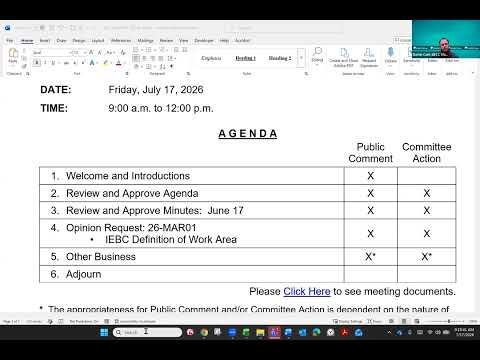
Tom Handy, chair pro tem of the BFRW committee, opened the July 17 meeting and asked Dustin, the presenter, to lead discussion of an opinion request from the City of Bellingham about applying fire‑protection rules in the International Existing Building Code (IEBC).
Dustin said the request had been narrowed from three questions to a single statewide question: "For the purposes of the fire protection, does a level 2 alteration work area need to consider all the work being done when portions of the work of the total work area being undertaken would maybe be considered level 1?" He reviewed relevant IEBC provisions, noting the definitions for "work area," chapter 7 (level 1 alterations), chapter 6 (classification of work) and chapter 8 (level 2 alterations), and said work areas must be shown on construction documents.
Dustin described the project that prompted the request: an early‑20th‑century, multi‑story building with both A and B occupancies where ceiling material was removed on one floor to access electrical and mechanical components. Because the building does not have a sprinkler system and the ceiling assembly provided some fire separation, the reviewer is asking whether the ceiling removal (arguably level 1 work) must be treated together with new wall reconfiguration (level 2 work) when calculating the work area for fire‑resistance requirements.
Dustin said his draft opinion is that "yes, all the work area, if it includes a little bit of Level 2 in there, the electrical mechanical stuff isn't incidental as a result of the movement of walls or installation of new walls, but expands the total work area to include the entire floor." He framed the conclusion as a proposed answer and asked for committee input and any clarifying information from the opinion requester.
Tom Handy asked whether the work was occurring on one floor or two; Dustin clarified it was on one floor and acknowledged he had misread the scope at a prior meeting. Another committee member asked how the 50% threshold works: Dustin explained the 50% test compares the alteration area against the total building area and that exceeding that threshold would trigger classification as a level 3 alteration with much stricter compliance. He said that, if the ceiling removal plus wall work together implicate a larger portion of the floor, the work area calculation can expand accordingly even if some tasks look like level 1 work in isolation.
Because only three members were present and four are required for a quorum, the committee did not take formal action on the opinion or the earlier motion to appoint Tom Handy as chair pro tem (the motion was noted and will be brought to a future vote when quorum is present). Members agreed to postpone formal consideration of the opinion to a future BFRW committee meeting or refer it to the full council and noted that having the opinion requester present could alter the discussion or the proposed answer.
Dustin confirmed upcoming hearings planned for Aug. 5 in Olympia at 1500 Jefferson and Aug. 7 at Spokane City Hall. With no other business and no quorum for votes, the committee adjourned.
The committee did not issue a binding interpretation during the July 17 meeting; the opinion remains a staff draft and the committee expects to revisit the matter when quorum is available or at the next council meeting.
AI generated
The text on this page is AI generated. Summaries, highlights, analysis, and video transcripts are all produced from the original source material.
AI can make mistakes, so if you spot one, and we will fix it for everyone.
Note: the source content is unaltered by us. Any content source we link to, be it a video, an audio recording, or a document, is presented exactly as its publisher released it. That publisher is usually a government body, sometimes an individual official or another organisation.