Get Full Government Meeting Transcripts, Videos, & Alerts Forever!
Get email alerts on the Twin Lakes topic
No spam. Unsubscribe anytime.
Twin Lakes improving but drought raises questions; committee to consider resilience review
Summary
John Farrell presented drone photos showing improvement in Twin Lakes and warned the area remains in exceptional drought; committee members noted treatments and aeration efforts and said they will pursue water sampling and resilience planning.
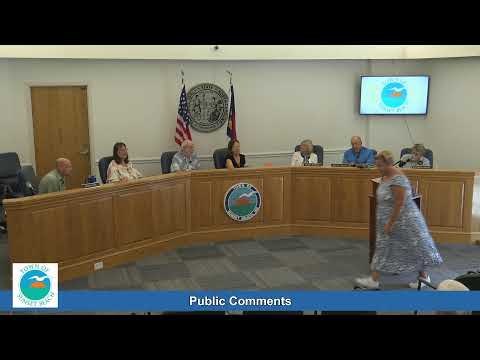
John Farrell showed recent drone photos and a short data review of Twin Lakes at the July 15 Environmental Resource Committee meeting, saying surface appearance has improved but long-term drought and sediment remain concerns.
"It's much better than it was a couple years ago," Farrell (S8) said, citing recent photographs that show clearer surface water and the effect of newly installed aerators in Eastlake. He also summarized local rainfall records he maintains and said the area has received substantially less precipitation than the 30-year average over the past six years; he added, "it would take about 3 feet of rain over the next 6 months to end the drought." Farrell said Brunswick County has implemented stage-3 mandatory water restrictions that limit public-water irrigation and similar uses.
Committee members and contractors reported recent treatments for invasive plants and algae in numbered lakes: Jennifer (Presenter S3) listed treated issues including alligator weed, pennywort, filamentous algae and spike rush across several lake sites and said treatment scheduling (once vs. twice monthly) will be clarified based on need. The committee asked for estimates on water sampling and bottom-sediment studies to better understand underlying conditions and identify longer-term remedies if chemical treatments prove insufficient.
Public commenters who live along the lakes praised improvements and asked additional questions. Mary Hughes (S9) asked whether mechanical weed harvesting is being considered if chemicals do not solve the problem; Jennifer (S3) said she is seeking estimates and follow-up funding. Candy Fogel (S10) suggested adding aerators in parts of Westlake where wind-driven debris accumulates and asked committee members to evaluate feasibility and budget implications.
The committee also discussed resilience planning. Farrell suggested reviewing the town's 2022 Resilient Coastal Communities program study and holding a special meeting focused on resilience priorities. Members agreed to follow up with county contacts for potential funding and to gather technical estimates for sampling and harvest options before the next ERC meeting.
Next steps: committee members will obtain cost estimates for water and sediment testing, clarify treatment frequency with contractors, and explore a resilience review meeting to examine broader stormwater and shoreline strategies.