Get Full Government Meeting Transcripts, Videos, & Alerts Forever!
Get email alerts on the Olmstead Plan Overview topic
No spam. Unsubscribe anytime.
North Carolina outlines updated Olmstead plan to expand community living, housing and employment options
Summary
State Olmstead officials described legal foundations and priorities for an updated five‑year plan — emphasizing housing access, competitive integrated employment, diversion from institutional settings and measurable outcomes — and set a public‑comment schedule aiming for a June 30 publication.
Deb Goda, North Carolina's Olmstead director, told a state webinar that the updated Olmstead plan will focus on concrete actions to help people with disabilities "live, work, play, get services, and live enviable lives in the community." Goda framed Olmstead requirements as grounded in federal civil‑rights law and urged programmatic shifts from activity counts toward measurable outcomes.
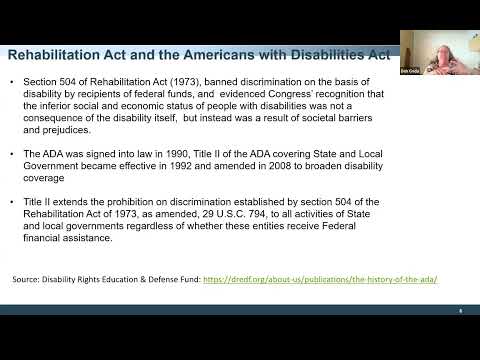
Goda walked listeners through the federal legal framework, citing Section 504 of the Rehabilitation Act and Title II of the Americans with Disabilities Act, and summarized the Supreme Court's Olmstead v. LC decision. "Needlessly isolating individuals is a form of discrimination which is based on disability," she said, summarizing the court's integration mandate and the obligation for public entities to administer services in the most integrated setting appropriate to the person's needs.
Officials identified four crosscutting priorities for the new five‑year plan: increasing access to home‑ and community‑based services and waivers; strengthening transitions from institutional settings back to communities; expanding competitive, integrated employment (defined as work at or above minimum wage alongside people without disabilities); and addressing crisis diversion, workforce shortages and data/quality‑assurance capacity.
Goda described state efforts that inform the plan: a 2012 settlement with the U.S. Department of Justice on transitions from adult care homes, a memorandum of agreement with Disability Rights North Carolina and the Center for Public Representation to expand competitive employment, and consent‑order work related to individuals in intermediate care facilities. She said the plan will align with other DHHS strategies and with regional housing plans created by MCOs and LME‑MCOs.
The department sought feedback through six virtual sessions, two in‑person meetings and a survey that returned 97 responses. Goda said technical assistance partners synthesized that input into both a plain‑language and a technical plan. "We want to shift from activities to outcomes," she said, noting the department will measure reach and impact rather than only listing meetings or trainings.
Timeline and next steps: the technical assistance collaborative is coordinating division meetings; a draft was expected in March, the department plans to post a draft for public comment in April, and officials targeted publishing a technical and plain‑language plan by June 30 with an implementation start date of July 1. Goda also said the department will continue quarterly reports and an annual progress report on Olmstead actions.
The webinar closed with organizers promising to post the recording and slides on the Inclusion Connects website and to publish answers to questions that could not be addressed during the live session.