Get Full Government Meeting Transcripts, Videos, & Alerts Forever!
Get email alerts on the Tbi Dashboard topic
No spam. Unsubscribe anytime.
North Carolina launches public dashboard tracking Medicaid service use for people with traumatic brain injury
Summary
State health officials released a public Traumatic Brain Injury (TBI) dashboard showing FY2024 Medicaid and state-funded service counts, explained privacy masking for small cells, and said the data will guide a state action plan released for public comment ahead of planned implementation on 2026-07-01.
State health officials on a webinar introduced a new public dashboard that displays how many people with traumatic brain injury (TBI) are receiving Medicaid and state-funded services in North Carolina, officials said.
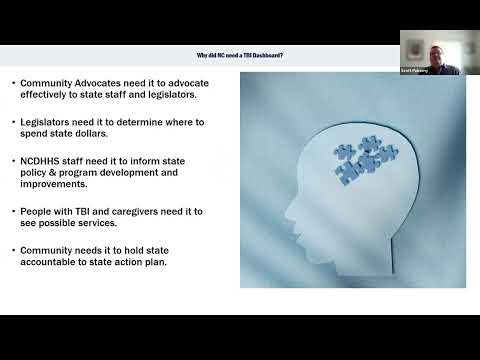
Scott Performa, TBI team lead for the Division of Mental Health, Developmental Disabilities, and Substance Use Services at the North Carolina Department of Health and Human Services, said the dashboard was created to provide transparency about who is being served and what services they receive after stakeholders requested clearer public data. "We recognize that while we were delivering services, we didn't really have a publicly accessible way to clearly show who is being served, what services they were receiving, and how often," he said.
The dashboard shows fiscal year 2024 (July 2023'June 2024) counts and filters by managed care plans and state-funded services. "You'll see 16,700 individuals, with TBI have Medicaid in fiscal year '24," said Ginger Yarbrough, chief clinical officer for the IDD, TBI and Olmstead section, who led a live demonstration of the tool. The presenters emphasized that the numbers reflect people who have "touched the public system," and do not represent total prevalence in the community.
Presenters explained how the tool will be used. Yarbrough said the state will apply a Plan-Do-Study-Act quality-improvement cycle to the dashboard data as part of state action planning, and pointed to one early signal from the data: only 58 people with TBI were shown accessing 1915(i) services in the reported period, compared with more than 10,000 people with intellectual and developmental disabilities who accessed those services. "58 seems super low," Yarbrough said, and presenters said that difference suggested gaps in awareness, eligibility, or referral pathways that the action plan will address.
Officials described how often the figures will update: Medicaid data will be refreshed every six months, while state-appropriations-funded data will be uploaded annually because of billing lags, Performa said. On privacy protections, Yarbrough demonstrated the dashboard's small-cell masking: "anytime there is a number that's under 11, we're just going to say less than 11," to avoid the possibility of identifying individuals when users cross-filter by geography and demographics.
The team said FY25 data are expected to be posted in the coming months and that maps and other features will be added to show geographic concentrations of services. They encouraged public comment on a draft state action plan that is slated to be posted for comment "early next week" and said the plan is scheduled for implementation on 2026-07-01.
Presenters provided contact information and said the webinar recording and slides will be posted to the agency's community engagement and training web page. They also offered to follow up on audience questions about CSV export and veteran-specific counts; officials said veteran data remain a work in progress because of data-sharing challenges across systems.