Get Full Government Meeting Transcripts, Videos, & Alerts Forever!
Get email alerts on the Innovations Waiver Waitlist topic
No spam. Unsubscribe anytime.
State IDD staff outline growing Innovations waiver wait list, dashboard and service gaps
Summary
State Inclusion Connects presenters said the Innovations waiver wait list is growing month over month, that about 15,000 funded slots are static until the General Assembly adds funding, and highlighted a new dashboard view showing time-on-waitlist by five‑year bands and county-level averages.
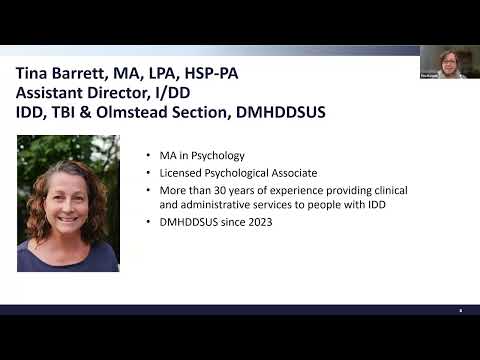
Tina Barrett, assistant director for IDD services in the Division of Mental Health, Developmental Disabilities and Substance Use Services, and Lauren Spencer presented findings from the program's January quarterly report and the Innovations waiver wait‑list dashboard, saying the list has continued to grow and that available slots remain fixed pending legislative funding.
"Unfortunately, there are not enough slots available ... which is why we continue to see this wait list grow," Lauren Spencer said, explaining that about 15,000 funded slots are static until the General Assembly provides more funding. She said the dashboard is intended to help staff and stakeholders understand who is on the list, what services they are receiving while waiting, and how long people have been waiting.
Why it matters: federal- and state‑funded waiver slots determine who can immediately access comprehensive IDD services. The presenters said dashboard metrics show increasing absolute numbers on the wait list even as the percentage of those on the list receiving some IDD services has held roughly steady, which raises questions about service access and the capacity of provider networks.
Spencer showed the dashboard's new wait‑time view, which groups people by five‑year waiting categories and reports county‑level averages. She emphasized the view does not show how long it takes to get a slot and excludes people who previously declined offers but remain on the list. Spencer also said autism spectrum disorder is the most frequently cited qualifying diagnosis among people on the list.
Barrett and Spencer reviewed service‑use and enrollment measures. They said about 81% of people on the wait list are enrolled in Medicaid, but Medicaid enrollment alone does not guarantee people are receiving IDD services. Barrett flagged workforce and utilization differences across LME‑MCOs and said staff are working with managed care partners to understand large discrepancies in billed versus authorized units, including the prevalence and billing patterns for relatives who provide services.
During questions, a participant identified as Carol asked whether Alliance is terminating long‑term services and supports (LTSS) as an "in‑lieu‑of" option because funds were exhausted by increases in applied behavior analysis (ABA) services. Ginger, a staff member who monitored Q&A, said she had not previously heard the report and that the team needed to check with DHB; she later said she had seen an Alliance notice the previous week and that staff would follow up. Barrett said the department will take questions and rumors back to partners and report clarifications.
The presenters said the Inclusion Connects site includes a public data summary and a video walkthrough of the metrics. Staff encouraged stakeholders to review the dashboard, join quarterly advisory meetings and submit topic suggestions. The next community advisory meeting is scheduled for April 20 at 11:00, and the webinar recording and slides will be posted to the Inclusion Connects website.