Get Full Government Meeting Transcripts, Videos, & Alerts Forever!
Get email alerts on the Zoning Variance topic
No spam. Unsubscribe anytime.
Planning commission approves setback variance for replacement home at 929 Center Street
Summary
The Crescent City Planning & Zoning Commission voted to approve a variance allowing a northern front-yard setback reduction to permit construction of a new single-family home at 929 Center Street. Staff said the replacement would bring the lot closer to compliance and improve neighborhood character.
The Crescent City Planning & Zoning Commission on June 18 approved a variance to reduce the north front-yard setback at 929 Center Street so a new single-family home can replace a nonconforming 1960 house.
Staff member (planner) S8 told the commission the 6,812-square-foot corner lot is in the SR-1 zoning district and that the existing structure and accessory buildings encroach on property lines. According to staff, the proposed new house would meet the SR-1 minimum living-area requirements and would remove the encroaching carport and shed, making the lot more buildable while remaining residential.
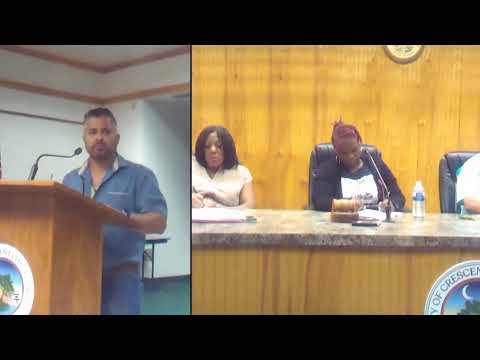
Deborah Graham, who identified herself at the public hearing and spoke in support on behalf of the project's proponents, said the replacement would “certainly enhance the neighborhood” and serve as a major improvement for a family. After public comment and questions about lot dimensions and plan details, a board member moved to approve the variance “as presented.” The motion was seconded; the commission conducted a roll-call vote and the measure passed.
The approval allows the north setback to be reduced from 25 feet to roughly 9–10 feet as described in the staff report. Staff noted that plans and building elevations were included in the packet and that removed accessory structures would be demolished as part of the work.
Next steps include the applicant obtaining the required building permit and any inspections tied to the permit process. The commission’s action was a recommendation as part of the quasi-judicial hearing and the recorded vote concluded the item at the meeting.