Get Full Government Meeting Transcripts, Videos, & Alerts Forever!
Get email alerts on the Bylaws Revision topic
No spam. Unsubscribe anytime.
CSEC Coalition reviews bylaws redline, debates membership rules, terms and removal procedures
Summary
At a March 17 meeting, the CSEC Coalition reviewed redlined bylaws (June 2022 baseline) and debated membership representation, application timing, term lengths, proxy rules and removal for missed meetings; DCFS will draft revised language for a posted proposal at the next meeting. Minutes were approved.
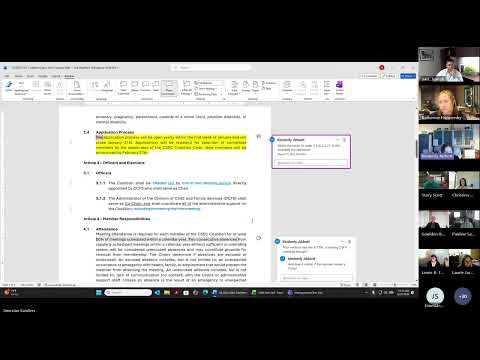
Maria Richardson, the coalition’s co-chair, opened the meeting and led a review of proposed amendments to the coalition bylaws, saying the changes would mostly be wordsmithing and formatting while a few provisions required substantive discussion. The group could not vote on amendments at the session because the bylaws require 10 days’ notice.
Why it matters: the coalition’s bylaws govern who sits on the statewide CSEC coordinating group, how members are replaced, how proxies count toward quorum, and attendance/removal rules. Members said clearer language would make the coalition easier to staff and maintain while protecting survivor-centered goals.
The chair walked members through redlined items and said most edits corrected typos or clarified phrasing. She identified a few substantive sections needing input: where the application process should sit in the bylaws, whether the bylaws should list required disciplines or use broader descriptors, terms of service, and how to replace vacancies outside the January application window.
Pauline Sala made the motion to approve the revised February 2, 2026 minutes, which Laurie Jackson seconded; the chair called for the ayes and announced the motion carried and the minutes would be posted. "I'll make the motion to approve," Pauline said; "I'll 2nd the motion," Laurie replied.
Several members urged shifting from an agency-specific list of required seats to broader language (for example, "mental health professionals serving CSEC youth") to reduce chronic vacancies when particular agencies cannot appoint representatives. April Stahl (DCFS) warned that naming agencies by title has historically caused problems when agencies closed or people could not fill slots; she recommended descriptive role-based language.
On terms and replacement, the group discussed two-, three- and four-year terms. April Stahl and others said two-year terms have been practical for turnover and administrative continuity; several members recommended allowing reappointment rather than imposing a forced break that would shrink available expertise. The chair said staff would draft language allowing vacancies to be filled between January application cycles.
Members flagged conflict-of-interest concerns. Melissa Holland (Awaken) asked whether people who profit from prostitution or owned brothels should be excluded from membership; committee members supported drafting exclusionary or removal language and agreed DCFS should consider such criteria in vetting applicants. "If you find out later that there's a conflict, there should be a way to remove someone," the chair said.
Attendance and proxies drew lengthy comment. Prior versions of the bylaws used inconsistent thresholds, some citing 75% attendance and others 50%; the draft limits proxies so they may not represent voting members for more than half of meetings in a calendar year. Members recommended distinguishing excused from unexcused absences and making the removal process consistent—one suggested removing members after two unexcused absences rather than three.
Next steps: staff will draft a clean version of the bylaws incorporating today’s feedback for posting at least 10 days before the next meeting and present it for formal consideration. The coalition did not appoint a new chair at the session; April Stahl publicly recommended Bridget Duffy for the role, but no vote or formal appointment occurred.
The coalition agreed these issues require clearer language to make membership sustainable while preserving the coalition’s survivor-centered mission. The chair closed the bylaws discussion and moved to the strategic plan review.