Get Full Government Meeting Transcripts, Videos, & Alerts Forever!
Get email alerts on the Superintendent Evaluation topic
No spam. Unsubscribe anytime.
Board hears CESA 6 briefing on DAPES superintendent-evaluation system
Summary
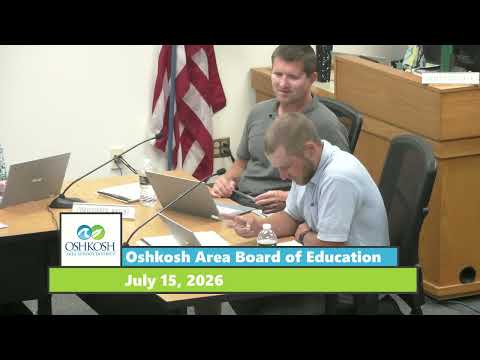
At its July 15 meeting the Oshkosh Area School District board heard Tim Kocher of CESA 6 outline the District Administrator Performance Evaluation System (DAPES), including a continuous-improvement cycle, six standards and a plan to use Frontline for goal-setting and summative reviews; the board scheduled goal-setting closed sessions for late summer.
On July 15, 2026, the Oshkosh Area School District Board of Education heard a detailed presentation from Tim Kocher of CESA 6 on the District Administrator Performance Evaluation System, known as DAPES. The briefing explained how the system would structure superintendent evaluation over a yearlong cycle of self-reflection, goal-setting, two progress checks and a summative review.
Kocher told the board DAPES is intended to provide a consistent framework for evaluation across districts and to help the board give growth-focused feedback. "We need to create a consistent, reliable process that's gonna make this experience for you as board members and for the district administrator," Kocher said. He described three common challenges for boards—different backgrounds among members, lack of day-to-day observation of the superintendent, and the difficulty of seven members arriving at a single summative judgment—and said DAPES addresses them through shared standards and evidence-gathering.
The DAPES model Kocher outlined uses six standards—strategic leadership; instructional leadership; human-resources leadership; operations and resource management; communication and community relationships; and professionalism—and a four-point rubric (distinguished, effective, developing, unacceptable). Kocher said the process begins with a superintendent self-reflection and the selection of two to three focused growth goals, proceeds with two progress-check sessions in closed session (typically between November and April), and culminates in a summative conference in June.
Board members pressed on how district-level KPIs should be incorporated into the evaluation. "What role do those KPIs play in the DAPES program? Do they or don't they?" one member asked. Kocher advised that KPIs can inform goal-setting but cautioned that district goals often require many hands and that the superintendent's evaluation should focus on the capacities the superintendent can reasonably be held accountable for leading.
Kocher also described administrative details for evidence collection and the technology platform: Frontline will host forms, progress-monitoring entries and the summative report, and one board member (identified in the presentation as Michael) will have edit access while other board members can view artifacts. He offered to provide guidebooks and e‑learning materials and said CESA 6 can play a facilitation role for the board's first run of the process.
The board and Kocher discussed next steps. Kocher recommended boards schedule a closed-session goal-setting meeting in July or September; the board agreed to a late‑summer timeframe. Chair announced a closed session date for goal setting and Kocher committed to sending materials and training links to the board the following day.