Get Full Government Meeting Transcripts, Videos, & Alerts Forever!
Get email alerts on the Project Spark topic
No spam. Unsubscribe anytime.
Project Spark officials say grant aims to move North Carolinians with disabilities from 14(c) jobs into competitive employment
Summary
State presenters said Project Spark, a $14 million SWITC grant, is midway through year four and aims to contact 700 people, enroll 450 and employ 250; they highlighted wraparound services, transportation and staffing challenges and reported 28 participants have achieved competitive integrated employment to date.
Project Spark presenters told an Inclusion Works webinar that a federal Disability Innovation Fund grant is funding a five-year initiative to shift people with intellectual and developmental disabilities away from 14(c) subminimum-wage jobs into competitive integrated employment.
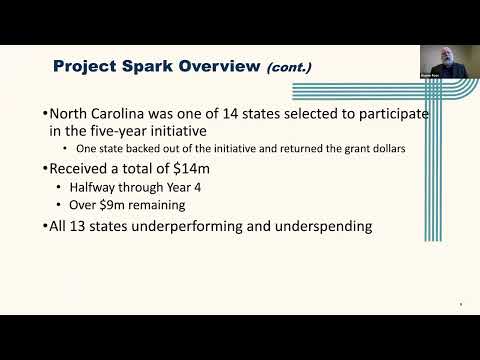
Shane Ross, introduced by presenters as the SWITC grantee director, said North Carolina received about $14,000,000 for the grant and, midway through year four, had roughly $9,000,000 remaining for program activities before the grant concludes. Ross described Section 14(c) of the Fair Labor Standards Act as the federal authority that historically allowed some employers to pay subminimum wages to people with disabilities, and said Project Spark seeks both individual placements and broader systems change.
"It's really about systems transformation," Ross said, arguing the initiative aims to reduce reliance on subminimum-wage employment and expand competitive integrated work opportunities. He reported the program had contacted 186 people and enrolled 177 through December, and that 28 participants had achieved competitive integrated employment; Ross said other SWITC states are underperforming or underspending against targets but that progress is being made.
Alma Taylor, assistant director for staff acquisition and employment initiatives with the Division of Employment and Independence for People with Disabilities (EIPD), and Bridget Hussain, Project Spark manager, described the program's operating model. Hussain said Project Spark runs three primary site partnerships ' Tri County Industries (Rocky Mount), Wake Enterprises (Raleigh) and Chatham Trades (rural) ' plus temporary mini-sites added in 10 additional counties to reach people on existing caseloads.
Hussain described the Spark team as including a community navigator, administrative support, at least two employment specialists, at least one peer mentor and a benefits counselor. She said each participant receives ongoing benefits counseling and that Spark deliberately bundles "community engagement" services (activities such as grocery trips, library visits or other supports to help people connect to their community) with employment supports.
"Every single person getting Spark services is supported by a benefits counselor," Hussain said, adding that the program provides technology (typically an iPad) to participants and that services continue through job retention, even after EIPD case closure.
Presenters flagged practical barriers: transportation is a large expense for rural providers, Tri County Industries reports significant costs to schedule or provide transport; Wake Enterprises has struggled with staff recruitment and leadership turnover; Chatham Trades' smaller size and limited public transport constrain scale. Panelists repeatedly identified stigma, family concerns about benefits or safety, and provider capacity as nonfinancial barriers that limit rapid expansion of competitive employment placements.
In audience Q&A, presenters said outreach events target people with IDD and that employer outreach occurs through separate, ongoing work; enrollment and referrals come through local EIPD offices and partner organizations, and team members encouraged individuals or agencies to contact local EIPD offices or the presenters by email for follow-up. Hussain listed outreach events on the calendar (including a March 17 event in Pittsboro and one planned for July in Raleigh) and shared an individual success story of a Spark participant placed at a Pizza Hut in Roanoke Rapids.
No formal votes or policy actions were taken during the webinar. Presenters asked participants with unanswered questions to follow up by email; slides and a recording will be posted on the Inclusion Works website and a brief survey will follow the event. The next Inclusion Works lunch-and-learn was announced for Wednesday, March 18 at noon.
Sources: presentation and Q&A by Claire Colligan (IDD employment lead), Alma Taylor (assistant director, EIPD), Shane Ross (SWITC grantee director) and Bridget Hussain (Project Spark manager) during an Inclusion Works webinar.