Get Full Government Meeting Transcripts, Videos, & Alerts Forever!
Get email alerts on the Greenhouse Gas Inventories topic
No spam. Unsubscribe anytime.
MAPC previews greenhouse-gas inventory tool, warns of common data limits
Summary
MAPC trainers outlined how municipalities can use greenhouse-gas inventories to set baselines, explained scope 1/2/3 accounting, and demonstrated MAPC’s Excel-based inventory tool while flagging data gaps (air travel, employee commuting, some transit and industrial emissions).
MAPC presenters on the MASM Academy training described how municipal greenhouse-gas inventories establish a baseline to measure progress and where communities typically encounter data gaps.
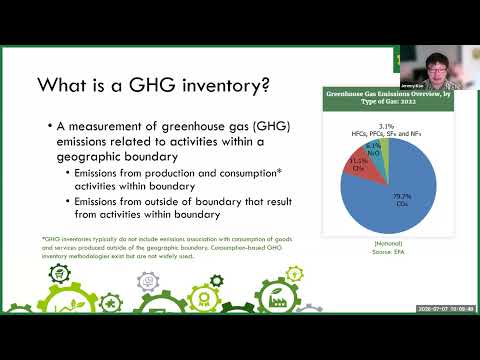
Jeremy Kim, assistant director of the clean energy department at the Metropolitan Area Planning Council (MAPC), said inventories measure emissions related to activities inside a community's geographic boundary and help identify what a municipality can directly control versus influence. "Greenhouse gas inventories are...a fundamental step to establish a baseline, to help you to measure progress over time towards reducing greenhouse gas emissions," Kim said.
Kim outlined scope accounting: scope 1 covers emissions occurring within the boundary (for example, combustion in buildings and local vehicle travel); scope 2 covers grid-supplied electricity generation attributed to the community's consumption; scope 3 covers emissions that occur outside the boundary but are driven by in-boundary activities, such as transmission losses or off-site waste processing.
The presenters demonstrated MAPC’s Excel-based inventory tool, first released around 2017, which includes step-by-step input tabs, links to public data sources and guidance. Kim said the tool is designed to meet the Global Protocol for Community-scale Greenhouse Gas Inventories (GPC) minimum reporting level and to be accessible for communities with limited staff capacity. He offered MAPC support and a contact email for technical assistance (cleanenergy@mapc.org).
Kim emphasized several recurring limitations users should expect. The tool intentionally focuses on publicly available, accessible data and therefore often excludes or undercounts categories such as aviation, many forms of passenger and freight rail, employee commuting and some industrial/process emissions. He also noted that certain regional transit agencies are not captured fully and that some off-road vehicle emissions and private commercial waste hauling may be omitted without supplemental inputs.
Using MAPC's Natick example, Kim cautioned against interpreting year-to-year changes without context. Natick’s tool output showed a 14% total emissions decline between 2017 and 2022 (an 18% drop in stationary energy and a 6% drop in transportation), but Kim said the change reflected multiple drivers — including a cleaner statewide grid mix, a municipal aggregation program that increased renewable energy procurement, weather differences (he noted 2022 was about 3% warmer by heating-degree days), growth in housing units and data lag — not solely local policies.
Kim said the tool can be extended with user-entered inputs to meet the GPC "basic plus" level where communities have the capacity and local data, but that MAPC designed the default workflow to be practical for municipalities without exhaustive local datasets.
The presenters closed by saying MAPC plans periodic updates to the tool and will share slides and links from the webinar. Kim invited attendees to submit specific questions about the tool to him or to the clean energy email address.