Get Full Government Meeting Transcripts, Videos, & Alerts Forever!
Get email alerts on the Transmission Infrastructure topic
No spam. Unsubscribe anytime.
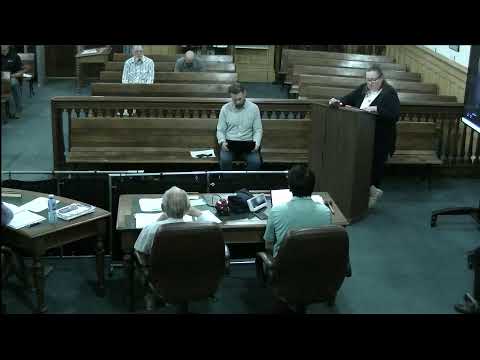
Storey County Planning Commission OKs NV EnergyGreenlink land-use approvals after debate over landowner consent
Summary
The commission approved special-use permits allowing NV Energyto place three 345 kV transmission corridors through a short stretch of Storey County and related height and equipment changes, while adding conditions that prohibit construction until property-owner authorizations or recorded easements are provided and other permits are in place.
The Storey County Planning Commission on July 16 recommended approval of land-use requests tied to NV EnergyGreenlink, including a special-use permit for three 345-kilovolt transmission corridors through a brief portion of Storey County and related tower-height adjustments and communications-equipment changes.
The commissionheard a detailed presentation from Charles Hutchinson, permitting manager for WSP, the project consultant to NV Energy, who described the Greenlink Nevada transmission project as a three-part program of lines and substations designed to add redundancy and resilience to the statewide grid. He said the application before the county covered the three common-tie 345 kV lines (Mira Lomato Walker River, Comstock 1 and Comstock 2), noted the BLMNEPA work already completed, and cited State senate bill 448 as a driver for bringing the system online by the end of 2028.
Hutchinson and NV Energy staff described the Storey County portion as a short segment (roughly three miles for one line, shorter for others), with the nearest residence about 1.2 miles away in the modeled alignments. He walked the commission through photo-simulations showing limited visibility from communities such as Virginia City Highlands and Mark Twain, explained access and temporary roads that would be reclaimed after construction, and spelled out the local, state and federal permits that must be secured before any physical work occurs.
That last point was central to public comments. Lucy Crow of Womble Bond Dickinson, counsel for Sunny Hills Ranchos, told the commission her clients own more than 800 acres subject to the application and urged denial because, she said, NV Energy had not obtained property-owner authorizations or recorded easements required by county practice and state law. Crow argued the application was incomplete, would encumber titles and could devalue property if the county approved land use before those property rights were secured.
Several nearby residents and landowners echoed concerns about the lack of site-specific disturbance plans, protections for cultural resources (petroglyphs), and detailed erosion and stormwater controls. John Wilson read a technical objection about missing impact reports; others asked how county staff would prevent off-highway-vehicle access and protect waterways during construction.
NV Energy representatives, including Hutchinson and Adam Gautaranda (engineering director), said the utility has negotiated many easements and affidavits but some landowners have not responded; they said filing for eminent domain is a rare, last-resort option and that the company would not construct on private property without consent. They also said the BLMNEPA process and federal environmental management measures require archaeological and biological monitors during construction on federal land.
Story County staff proposed and the commission included a condition requiring the applicant to demonstrate recorded easements or signed owner authorization to the county before any grading or construction permits are issued. Commissioners debated whether to continue the hearing until all authorizations were in hand but several said a conditional approval that prevents construction absent property-owner authorization and other state/federal permits would protect residents while allowing project review to continue.
Planning commissioner Starett moved for approval of special-use permit 2026-029 with the staff-recommended conditions; the motion carried on a majority vote (4-2). The approval covers the three corridors as land use only; staff and commissioners emphasized that separate grading and construction permits will be required and that those will not be issued without the property-authority condition being met.
The commission also approved related planning items tied to transmission infrastructure: a separate special-use permit to raise certain tower/equipment heights and an earlier request to add 12 feet to an existing communications tower at 662 Italy Drive. Staff said those approvals likewise authorize land use and height allowances, and that FAA clearances, local grading permits and other state/federal authorizations remain prerequisites to construction.
What happens next: the items approved by the Planning Commission will move to the Board of County Commissioners (or progress through the county permitting pipeline where applicable). County staff said that before any physical construction begins, NV Energy must deliver evidence of easements or owner authorization for the affected parcels and must obtain the state and federal permits discussed in the hearing.