Get Full Government Meeting Transcripts, Videos, & Alerts Forever!
Get email alerts on the Municipal Budget topic
No spam. Unsubscribe anytime.
Finance chair recommends trimming proposed property-tax hike to 2.2¢; committee backs recommendation
Summary
The city council committee voted to recommend a lower 2.2¢ property-tax increase to the full council while keeping a 3% merit pool for employees and pledging no layoffs; staff detailed follow-ups on benefits, a $400,000 utilities-refunding savings, and possible program reductions.
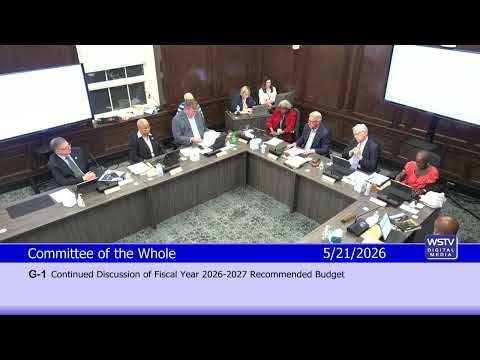
Council member Clark, chair of the finance committee, recommended lowering the city’s proposed property-tax increase from 2.6¢ to 2.2¢ and the committee voted to forward that recommendation to the full council. The committee meeting on the FY26–27 budget included staff follow-ups on benefits, several proposed general-fund reductions, and a preview of accompanying ordinances the council will consider on June 1.
Clark framed his recommendation as a modest adjustment intended to show fiscal restraint while preserving employee merit increases and avoiding layoffs. "What I'm recommending not a 2.6% increase in the property tax rate, but a 2.2¢," Clark said, and he asked the committee to accept related line-item changes that would keep the 3% merit pool in place and leave the $115,550 unallocated community-agency amount intact.
The recommendation follows a staff presentation of a response packet sent to council the previous evening. City Manager Tesh and finance staff detailed several options that together could reduce the general-fund shortfall by roughly $2.4 million, including a technical $400,000 savings from a water-and-sewer bond refunding. "They built that into their recommended budget ... we are just putting this into the city's budget as they recommended it," Tesh said about the utilities commission's refunding savings.
Staff also summarized benefits information and merit implementation timing. A benefits presenter reported the proposed plan would cover about 87% of premiums and require employees to cover about 13%; she explained the city's approach to merit pay eligibility and transitions between brokers. "The city is what we're proposing would be 87% for the employer share cost and 13% for the employee," the presenter said.
Among specific reductions discussed were: correcting stormwater-fund position assignments; a $250,000 reduction in leased public-safety phone lines after vendor review; projected revenue increases at Winston Lake Golf Course; eliminating the decorative streetlight subsidy for HOAs (shifting the upcharge to HOAs); and consolidating in-person revenue collections from the Black Phillips Smith satellite office to the Bryce A Stewart building, which staff said averages about 39 in-person transactions per day.
Council debated which community groups should be funded from general-fund community-agency allocations and which should be supported by occupancy-tax (hotel-room) dollars. Several council members asked staff to confirm in writing how organizations like Colladium/Caladium qualify for occupancy-tax funding — which state law generally ties to tourism and heads-on-beds outcomes — before moving money between pots.
Staff presented cost estimates for any cost-of-living adjustment (COLA), saying a 1% COLA effective in January would cost roughly $1.13 million on a half-year basis and that COLA would be additive to the 3% merit pool in the budget. Staff also warned that deferring merit payments into the next fiscal year simply changes the base budget and makes future liabilities larger if not otherwise offset.
After discussion and motions, the committee held a voice vote on Clark’s recommendations. The chair announced the motion approved and reminded members that this committee-to-hold recommendation will be presented to the full council on June 1 for final action. "That is approved," the chair said after the vote.
The meeting concluded with staff previewing the budget package’s ordinances and resolutions — including appropriation and tax-levy ordinances, the capital plan resolution, opioid-settlement allocations, user-fee changes and personnel-resolution adjustments — that will accompany the June 1 council vote.
What happens next: the finance committee’s recommendation will go to the full council on June 1. Staff told members they will return with written clarifications on occupancy-tax eligibility and more detailed analyses of the proposed personnel and program changes.