Get Full Government Meeting Transcripts, Videos, & Alerts Forever!
Get email alerts on the Budget Overview topic
No spam. Unsubscribe anytime.
Winston-Salem budget workshop outlines 2.6¢ property tax increase to cover rising health-care and public-safety costs
Summary
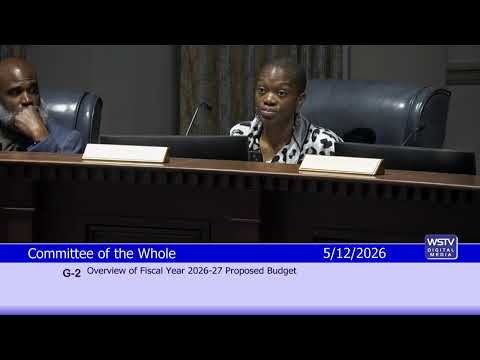
City staff presented a proposed FY27 budget that includes a 2.6¢ property tax increase (generating roughly $12 million), a 3% merit pool for staff, $8.4 million in health benefit cost increases, a $1.96 million Axon police contract impact, and $19 million in vehicle/equipment replacement; the council will hold a public hearing next week and consider adoption June 1.
City staff presented a proposed fiscal year 2027 operating and capital budget that would raise the property tax rate by 2.6¢ and prioritize public safety, benefits and equipment replacement.
"This proposed budget includes, again, a 2.6¢ tax rate increase, which is, 4.6%. It is only for the general fund," Scott Tesh, the budget presenter, said, adding the increase would generate almost $12 million in new revenue for the general fund. Tesh told council members that more than half of general fund spending is for public safety and that two-thirds of the year-to-year increases are related to public safety costs.
Health-care cost growth is the main driver of benefits increases in the draft budget. Tesh and the human resources director reported the city’s medical claims are trending higher (staff cited roughly $28,000,000 in claims as of January) and that the FY27 budget includes about $8.4 million in additional health-care-related costs for city funds. Human resources presented recommendations to raise deductibles, increase primary care and specialist copays, raise maximum out-of-pocket limits, and move some preventive branded medications (including GLP‑1 weight-loss drugs) off a $0 copay into tiered copays. Staff recommended an overall 7% premium increase for employees and retirees and said the proposed plan changes—and an employee cost-share adjustment totaling about $2,000,000—would take effect in January.
The draft budget also includes a 3% merit increase for employees who “meet expectations.” Tesh estimated each 1 percentage point of merit in the general fund costs roughly $1.3 million; he said a 3% merit pool would be north of $4 million in general-fund cost. Council members pressed staff for peer comparisons on employer/employee splits; staff said many localities fall in a 60/40 to 75/25 employer/employee range but that the city is currently in a higher employer-share position (about 83/17).
Public-safety technology and equipment are notable line items. The presentation lists an Axon police contract with a net impact of approximately $1,960,000 and a broader vehicle/equipment package of about $19,000,000 that includes roughly 80 police pursuit vehicles and two specialized fire apparatuses. Tesh said some current vendor contracts are being consolidated as Axon expands and that IT and enhanced cybersecurity initiatives are also driving non-personnel increases.
Staff emphasized the proposal is a “no‑frills” budget: several department requests are not funded in the draft, including roughly $3,000,000 of personnel requests, nearly $7,000,000 of non-personnel operating requests and $4,000,000 for affordable housing production. Tesh noted that the manager has discussed a separate half-cent tax option for housing (which would generate an estimated $2,000,000), but that no additional housing funding is included in the proposed FY27 budget without further council action on revenue.
Tesh closed by outlining next steps: additional budget workshops this week, a public hearing next Monday evening, and a scheduled adoption vote on June 1.