Get Full Government Meeting Transcripts, Videos, & Alerts Forever!
Get email alerts on the Bank Stabilization Project topic
No spam. Unsubscribe anytime.
Red Lodge officials outline bank‑stabilization plan at 19th Street and Highway 212
Summary
Red Lodge held a public hearing on a proposed bank‑stabilization project adjacent to the bridge at 19th Street and Highway 212. City staff and a consultant presented a draft environmental assessment that calls for angular riprap, root wads and willow plantings to protect infrastructure and improve habitat; public questions focused on natural restoration, downstream impacts and funding.
Red Lodge held a public hearing to review a proposed bank‑stabilization project at the northwest bridge abutment where 19th Street meets Highway 212, city officials said. Bailey, the project presenter and an engineer, summarized a draft environmental assessment and invited public comment.
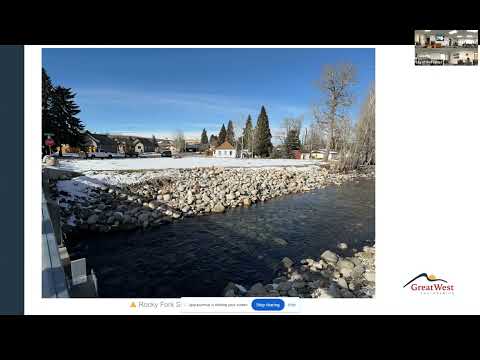
The project would stabilize roughly 150 lineal feet of riverbank adjacent to the former Rocky Fork Inn property damaged in a 2022 flood. Bailey said the city has completed survey work, preliminary design and hydraulic modeling and has contracted a consultant to advance the project to construction pending permits. "This is a public hearing to garner feedback on the Rocky Fork Bank Stabilization Project," Bailey said.
Why it matters: officials said the work is intended to protect the bridge wing wall and abutment, reduce ongoing erosion and create an opportunity for future use of the parcel while minimizing long‑term maintenance. Bailey and other speakers emphasized that the design seeks to avoid any increase to the river's surface elevation; a permit would not be issued if the project caused a rise in water level.
Design and mitigation: the draft assessment describes placing angular riprap—about 3 to 4 feet thick—embedded into native soil, reshaping the bank to match existing slopes (roughly 2.5:1 to 3:1), and planting willow stems to promote vegetative stabilization. The plan includes installing at least one root wad (a large, anchored tree root mass) to create scour and fish habitat. Bailey said the finished surface above the riprap would receive topsoil and be hydroseeded.
On planting numbers and sourcing, Bailey described two different figures in the presentation: in one place she described the planting zone and an estimate for stems, and later noted that a contractor on a prior project harvested about 8,000 willow stakes regionally. The record also includes an unclear numeric line in the transcript; the exact number of willow stakes to be used on this project will be finalized in design and is not specified in the draft assessment.
Questions and concerns: members of the public asked whether a more natural restoration approach had been considered. Bailey said engineers often prefer angular riprap where work is immediately downstream of critical infrastructure, citing concern that other techniques may fail under high velocity flows. "If this project doesn't hold, it's going to reflect on me as a design engineer," Bailey said, and added that a hybrid approach—including coarse wood and river cobble—was used in lower‑velocity patches on a prior project.
Permitting, outreach and timing: Bailey said the city plans to submit a joint permit application to state and federal agencies including Montana DEQ, Montana Fish, Wildlife & Parks, the U.S. Army Corps of Engineers and the local floodplain administrator. The draft environmental assessment was placed on display at City Hall and agencies were given a 30‑day comment window; Bailey said she had received one substantive emailed comment from Katie Young, identified in the record as a Veriteous project manager. If permits and procurement proceed without delay, Bailey said construction could occur as early as late summer or early fall, though willow‑stake sourcing and permit timelines make exact timing uncertain.
Cost and procurement: Bailey offered a preliminary cost estimate of roughly $80,000 for construction. She and other speakers discussed prior funding for a comparable project and noted a likely funding mix could include large federal support (Bailey said she believed previous work was about 75% FEMA funding with a 12.5% local match), but final funding sources for this specific project are not specified in the record. Because of procurement thresholds, the city would solicit bids from three contractors if the project stays below the applicable $80,000 threshold; if bids exceed that amount, a different procurement path would be required.
Next steps: Bailey said she would keep the comment period open for several days to receive additional input, consider changes to the draft environmental assessment based on written comments, and then coordinate with legal or council leadership about any resolution or signature needed to move the project from draft to official status. The mayor closed the hearing after a final call for comments and reminded the public that the council packet would be published for the next meeting.
Note: the draft environmental assessment and written public comments will become part of the official record and are available for review at City Hall during the comment period, per Bailey.