Get Full Government Meeting Transcripts, Videos, & Alerts Forever!
Get email alerts on the Resort Tax Survey topic
No spam. Unsubscribe anytime.
Resort-tax review committee: survey shows strong support for streets and sidewalks; AI used to summarize comments
Summary
The Red Lodge Resort Tax Review Committee reviewed a 524-response survey showing residents rank streets and sidewalks highest among resort-tax priorities, heard that ChatGPT assisted in analyzing open-ended comments, and agreed to post raw data and AI summaries on the city website for public review.
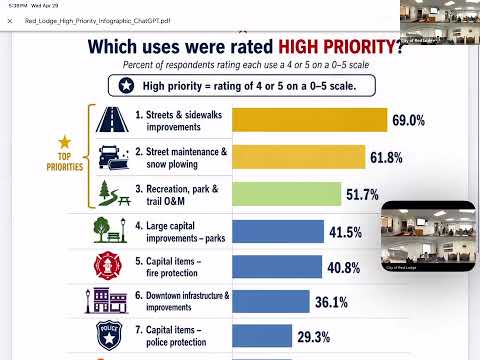
The Red Lodge Resort Tax Review Committee reviewed results of a city survey on uses of resort-tax funds and heard that respondents prioritized streets and sidewalks above other uses.
Chair (speaker 4) said the survey drew 524 responses, including 281 city residents and 236 property owners, and that “overall the community is very positive about the resort tax.” He told the committee he had used AI (ChatGPT) to help categorize and analyze open-ended comments and that he personally reviewed the AI outputs for accuracy.
Why it matters: the survey will inform the committee’s recommendation to the mayor and city council about next year’s resort-tax budget. Committee members noted the difference between visible, on-the-ground investments (streets, sidewalks, parks) and larger, less-frequent capital projects in how residents express priorities.
The presenter summarized headline findings: streets/sidewalk improvements and maintenance ranked highest (mean ~3.7, median 4); recreation and park operations ranked highly as a second tier; large public-works capital projects scored lower on average. On a question asking whether respondents would support repurposing resort-tax funds away from currently-allowed categories, workforce housing and public transportation were only marginally positive and using the tax for police officer salaries was broadly opposed.
Committee members asked about survey integrity and methodology. The presenter said AI checks flagged a small number of unusual entries but found no evidence of manipulation that would change the overall results. He emphasized the committee would post the full raw responses, the AI-generated categorizations, and the presenter’s notes on the city’s resort-tax page so residents can review the underlying data.
Committee member Jeff Wise (speaker 9) supported using a simple decision matrix rather than a full formal study to prioritize projects, saying it would help surface trade-offs and keep flexibility in the spending plan.
Next steps: staff confirmed the materials (raw data, AI summaries, and infographics) would be posted on the resort-tax section of the city website by midday the next day and that the committee would provide a recommendation to the mayor for the council’s consideration.