Get Full Government Meeting Transcripts, Videos, & Alerts Forever!
Get email alerts on the Overdose Surveillance topic
No spam. Unsubscribe anytime.
State epidemiologists explain why finalized overdose death data lag and how they’re providing timelier estimates
Summary
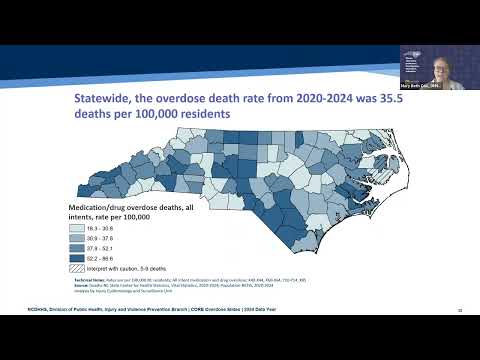
Division of Public Health epidemiologists told OP DAC members that death certificates produce detailed but slow final overdose counts (final through 2024); they described active surveillance (ED data, suspected‑overdose measure) and provisional methods the state now uses to produce more timely estimates and county alerts.
Tyler Yates, state opioid coordinator, opened the June OP DAC webinar and turned the meeting over to substance‑use epidemiologists to review how North Carolina tracks overdose trends.
Marybeth Cox, a substance‑use epidemiologist with the Division of Public Health’s Injury and Violence Prevention Branch, said routine death‑certificate data are detailed and final but slow: “If you remember nothing else from today’s presentation, please remember that we are here to support you in the work that you do.” She explained the tradeoff between passive surveillance (detailed but delayed) and active surveillance (timelier but less complete).
The division’s finalized death data are current through 2024. Cox said the state’s death‑certificate files show a decline in the final 2024 overdose rate — 26.6 deaths per 100,000 residents — but cautioned that provisional 2025–2026 figures undercount pending investigations and toxicology results. To avoid misleading readers, the state presents final counts when possible and clearly flags provisional estimates.
To provide faster situational awareness, the division uses NC DETECT emergency‑department data (twice‑daily refreshes) to flag unusual county‑level increases and notify prevention partners. Cox described a suspected‑overdose measure developed with the Office of the Chief Medical Examiner (OCME) that runs on a roughly two‑week lag and closely aligns with later confirmed counts, allowing earlier detection of trends: using these measures, the division saw a 10–14% decline in some indicators from 2024 to 2025.
Cox also described NC SUITORS (the state unintentional drug overdose reporting system), which aggregates investigative information about decedents (route of administration, bystander presence, naloxone administration, prior overdoses and co‑occurring mental illness). Those county‑level SUITORS reports are available on the division’s website and can support local prevention planning.
The division offers epidemiology office hours and a public dashboard with provisional estimates and interactive county views. Cox urged local partners to request tailored analyses when they need more granular or subcounty insights.
The webinar closed that segment with reminders that provisional estimates should be treated cautiously and that the state is expanding timelier metrics to help local responders and planners.