Get Full Government Meeting Transcripts, Videos, & Alerts Forever!
Get email alerts on the Stormwater Drainage topic
No spam. Unsubscribe anytime.
Sewall's Point approves up to $70,000 to address repeated flooding at 1 Mandalay after lengthy drainage debate
Summary
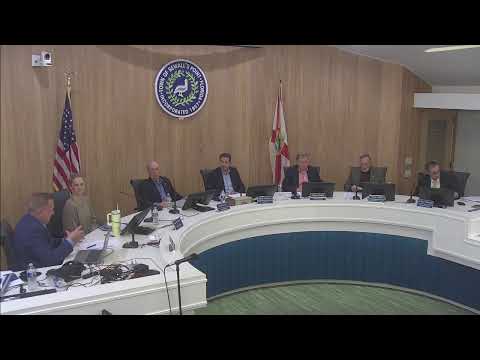
After a lengthy presentation and public testimony about recurring flooding, the Sewall's Point commission directed staff to pursue prioritized drainage work and approved a motion to spend up to $70,000 on a near‑term, cost‑effective fix for a severely affected property at 1 Mandalay.
The Sewall's Point Town Commission voted Jan. 14 to authorize up to $70,000 from existing road‑project funds for a near‑term, cost‑capped remedy to reduce flooding at 1 Mandalay and to direct staff and the town engineer to return with firm cost estimates for prioritized public‑right‑of‑way improvements.
The decision followed a technical presentation by the town engineer outlining three tiers of work: public‑right‑of‑way drainage improvements (the "blue" items), inlet and control structures (the "red" items) and optional private‑property retention or berm work (the "green" items). The engineer told commissioners the work would “help the problem” but cautioned it would not fully eliminate flooding in all storms.
Residents whose properties have repeatedly ponded water described safety, health and property‑value consequences. One longtime homeowner asked the commission to “move forward and do it quickly,” saying the backyard and driveways remain soggy after heavy rains. Jason Bolton, a neighborhood resident, urged reducing the speed limit and mentioned enforcement as part of traffic‑calming conversation; multiple residents also urged mechanical and design fixes to the drainage system.
Commissioners debated tradeoffs. Some members pressed for a phased approach — test yard drains and swales first, then pursue larger works if needed — while others argued the town has a responsibility to remedy problems caused or exacerbated by earlier public‑works phases. The engineer estimated individual control structures could cost roughly $15,000–$25,000 each and said swale installation runs roughly $30 per linear foot; he also noted an alternative bid of about $70,000 for a private‑property retention/adjustment package.
Commissioner Fender moved (later amended) that the town resolve part of the homeowner's problem in the most cost‑effective manner, capped at $70,000. The motion carried on a 4–1 vote: Fender — yes; Titticus — yes; Mayfield — no; Vice Mayor Burrell — yes; Mayor Kurzman — yes. The commission directed staff and the engineer to provide firm estimates for the blue (public) items and the private‑property option before the next meeting.
The town manager said staff will attempt to provide the requested figures for the next meeting's agenda but noted time constraints around a holiday and agenda deadlines. The engineer reiterated that, beyond the immediate fix, the town is pursuing grant funding for larger projects and a stormwater master plan that would recommend additional measures across phases.
Next steps: staff and the town engineer will prepare line‑item cost estimates for the public‑right‑of‑way fixes and the private‑property remedy, proceed to seek the homeowner's cooperation for easements if needed, and return to the commission with options and recommended sequencing.