Get Full Government Meeting Transcripts, Videos, & Alerts Forever!
Get email alerts on the Infrastructure topic
No spam. Unsubscribe anytime.
State auditor: more than $61 million spent on Mid Currituck Bridge with no construction; report calls for a decision
Summary
North Carolina State Auditor Dave Bullock presented a rapid‑response audit to the Currituck County Board showing more than $61 million spent on the proposed Mid Currituck Bridge with no construction; the report cites rising cost estimates, falling traffic projections and an estimated ~$700 million funding shortfall, and urges state leadership to decide whether to proceed.
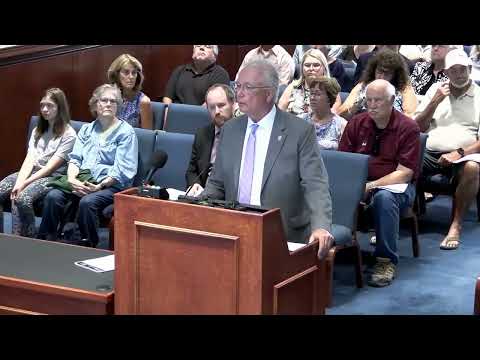
State Auditor Dave Bullock told the Currituck County Board of Commissioners on June 22 that his office’s rapid‑response review found the state has spent "north of $61,000,000" on the proposed Mid Currituck Bridge while "not a single piece of dirt has been turned." The presentation, led by Bullock and deputy auditor Charles Dingey, condensed decades of project records, cost estimates and traffic studies and laid out financing constraints facing the plan.
Bullock said his office created the rapid‑response unit to give local decision‑makers timely, data‑driven information. "We are elevating this to the point that this will now be known across the state," he said, framing the report as a prompt for a clear choice: either secure funding and move forward, or declare a no‑go and redeploy committed dollars.
Charles Dingey, the deputy auditor who led the team, walked commissioners through the report's timeline and numbers. He said the Federal Highway Administration first published notice of the project in 1995 and that early construction estimates were roughly $490 million. Dingey said construction estimates have since risen to just over $1,000,000,000 and that, according to DOT figures the audit reviewed, a March update put the estimate at $1,200,000,000. He told the board the audit found more than $26,000,000 spent on environmental studies and legal defense and calculated a current funding shortfall of about $700,000,000 based on available commitments.
The auditors also reported declining traffic projections: Dingey said traffic forecasts used to project 12,600 vehicles per day but that the auditors found a reduced projection of about 7,700 vehicles per day, a drop that he and Bullock said reduces toll‑backed borrowing capacity by roughly 42 percent. "Because there has been less projected traffic, you would be able to borrow less money for the project," Dingey said.
Bullock emphasized that the audit does not decide policy. "I'm not here to tell you what the right answer is, whether to go or no go," he said. "What I am here to say is that it's time for leadership in Raleigh." He added that about $173,000,000 of ARPA funds have been set aside for the project but that there is currently no signed construction contract nor an approved total funding package.
Local commissioners and board members framed the audit as an opportunity to get a definitive answer after decades of uncertainty. Commissioner Peyman, who said he grew up in the area, asked for a definitive "yes or no" from decision‑makers after repeatedly mixed signals about funding. Commissioner Rose thanked the auditors for transparency but expressed skepticism that the project will happen without clear evidence: "we'll believe it when we see it," she said.
Members also asked technical questions. Miss Jarvis asked whether the auditor's office can audit public‑private partnership arrangements and tolling; Bullock replied that the office has authority to audit any entity receiving public dollars, including private contractors and P3 arrangements, and said his office had provided an advance copy of the report to DOT and legislators.
Bullock told the board he would provide the DOT traffic study and related documentation to the commissioners on request. The presentation closed with the auditor urging local leaders and DOT to make a prompt decision so taxpayer dollars can be redeployed if the project is a no‑go or allocated to construction if the state chooses to proceed. The special meeting was then adjourned.