Get Full Government Meeting Transcripts, Videos, & Alerts Forever!
Get email alerts on the Water Quality topic
No spam. Unsubscribe anytime.
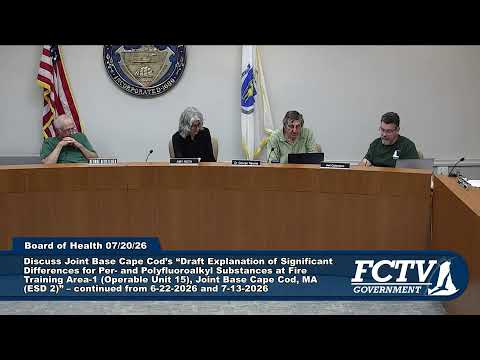
Falmouth health board hears water-department update on lead service-line inventory and PFAS monitoring
Summary
Water Superintendent Matthew Linn told the Board of Health the town will use DEP-approved statistical sampling this year to assess roughly 13,000 ‘unknown’ service-line records out of ~23,000 total; the board also discussed PFAS plumes and temporary treatment at Fresh Pond.
Matthew Linn, Falmouth’s water superintendent, told the Board of Health on July 20 that the town started from an estimated 23,000 water service connections and currently has about 13,000 listed as “unidentified.” Linn said the department will pursue DEP‑approved statistical sampling of roughly 300 properties this summer rather than a full, door‑to‑door 10‑year inventory if the samples meet DEP thresholds.
“We started with about 23,000 water service domestic and fire, through the whole community,” Linn said, adding that “out of those 23,000 give or take service lines, 13,000 were unidentified.” He described the outreach to unknown accounts (mailers that produced about 800 responses) and planned hydro‑excavations to physically confirm a homeowner’s service-line material where needed.
Linn described the town’s approach as pragmatic and DEP‑driven: after mailings produced limited responses, the town gained DEP approval to use a statistical method that reduces the number of required in‑home inspections by sampling a representative set of homes. “Since July 1, we just—we’re about to send out the mailers to the 300 homes or businesses that have unknowns to get those done hopefully before the end of summer, early fall,” he said.
Board members asked about age-based targeting and whether certain neighborhoods are likelier to contain older materials. Linn said age can correlate with service-line material but gaps in GIS and record‑drawing updates mean many newer developments can still be labeled ‘unknown’ in the system.
The Board also discussed PFAS contamination and treatment efforts connected to nearby training areas. A town operator and a water‑system chief reported that a temporary treatment system (ion‑exchange and carbon components) is in place at Fresh Pond and that test wells and new‑source approvals are under way to evaluate whether additional sources such as the Schumacher (Ashuman) well can be returned to service with adequate treatment.
“We’re pulling out 500 GPM and removing all the PFOS that we know of,” the chief operator said, describing monthly PFAS‑6 reporting to DEP and broader compound monitoring.
The board requested the water department share sampling and algae testing results and asked staff to return with updates once the 300 statistical inspections and pothole excavations are completed. The town’s outreach partner for the lead inventory, Tate & Howard, will consolidate incoming homeowner responses and forward them to the water department.
Next steps: the water department will send the 300 statistical mailers, complete excavation confirmations where needed, and return to the Board with results and any policy implications for outreach or remediation.