Get Full Government Meeting Transcripts, Videos, & Alerts Forever!
Get email alerts on the Property Taxes topic
No spam. Unsubscribe anytime.
City of Douglasville outlines proposed 2026 millage rate; homeowner raises reassessment concerns
Summary
Assistant City Manager and CFO Karen Callan told a morning public hearing that the city’s M&O millage will remain at 8.749 while the bond millage is decreasing from 1.287 to 0.9, lowering the city’s total proposed rate from 10.036 to 9.649; a recent homeowner urged clearer assessment information for residents.
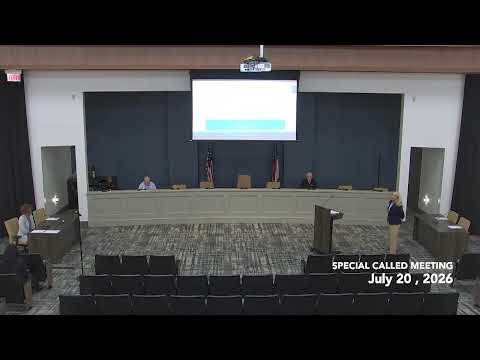
Karen Callan, the assistant city manager and chief financial officer for the City of Douglasville, opened the first of three required public hearings on the city’s proposed 2026 millage rate and walked attendees through how the rates would affect individual taxpayers.
“Our total maintenance and operation millage rate is not increasing. We’re keeping at the same level as last year at 8.749,” Callan said, noting that the bond millage is falling and that bond rates approved by referendum are not required to be advertised under state rules.
Callan said the bond millage is decreasing from 1.287 to 0.9, which reduces the city’s total proposed millage from 10.036 to 9.649. She gave an example to illustrate the change: for a property with the same assessed value in the prior and current year, the bond decrease would reduce the annual city tax bill by $54.
The presentation emphasized the distinction between the maintenance-and-operations (M&O) millage — which funds utilities, fuel and other general fund services — and the bond millage, which is restricted to paying debt service. Callan also explained that the City of Douglasville does not set property assessments: the tax assessor’s office determines values and handles appeals, while the Douglas County tax commissioner’s office issues bills and collects taxes.
“We have to advertise for a tax increase” even when the millage rate is unchanged, Callan said, because state rules require cities to notify taxpayers that reassessments can raise individual tax bills. She provided digest figures from the current reassessment cycle: commercial personal property up 101%, total real property up 24%, residential real property up 11%, industrial property up 78%, and industrial personal property down 76%. Callan said new growth accounts for about 13% of proposed revenue and reassessed property about 7%.
Callan framed the decision to keep the M&O rate steady as a response to inflationary pressure on operating costs and said maintaining the current rate positions the city to adapt to possible state-level legislation that could cap assessed-value growth for residential property at CPI (she cited a 3% cap discussed in the legislature).
During public comment, Jaconda Anderson, who identified herself as a recent homeowner at 8113 Field Stream Way, said she was concerned about fluctuating home values in her neighborhood and asked how assessments were being calculated. “I just have a little concerns in the area about the rate going up a little bit,” Anderson said, adding that some homes in her subdivision need repairs and that she had applied for the homestead exemption.
A city representative explained that homeowners may appeal assessments and described the time-limited appeal process before the assessor’s office, which operates independently of the city. When a resident asked what determines reassessment timing, Callan said assessors look at surrounding market values, comparable sales and 'comps.'
Callan closed by noting there are two more public hearings — one the same evening at 6:00 p.m. and a final hearing on Aug. 3 at 5:00 p.m. — and that the city plans to adopt the millage at a special called meeting at 5:30 p.m. She reminded attendees that the hearings are designed to gather public input rather than operate as full question-and-answer sessions, and she provided contact information for follow-up discussions.
The hearing included time for informal follow-up at the microphone after the formal presentation; officials said they would take additional questions at the evening session and the Aug. 3 hearing.