Get Full Government Meeting Transcripts, Videos, & Alerts Forever!
Get email alerts on the Public Safety topic
No spam. Unsubscribe anytime.
Bozeman city officials brief school trustees on proposed fire station bond and first‑responder staffing levy
Summary
City officials told the Bozeman Public Schools Board that two separate ballot questions would fund a West‑side Fire Station No. 4 and a phased five‑year first‑responder mill levy to hire 30 police officers, 22 firefighters and 11 non‑sworn staff; presenters estimated the levy would ramp to about $35 per month for the median homeowner.
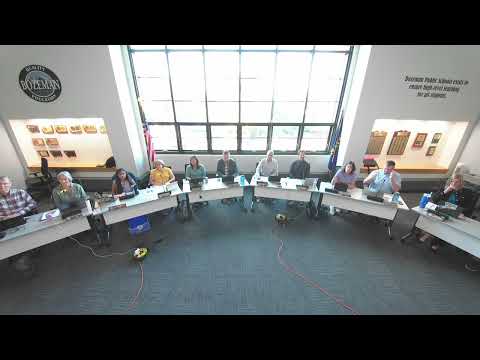
Bozeman city officials appeared before the Bozeman Public Schools Board to explain two separate ballot questions voters will see: a bond to build and equip Fire Station No. 4 on the city’s west side, and a first‑responder mill levy to phase in additional sworn and non‑sworn staff over five years.
Commissioner Douglas Fisher opened the education session and turned the presentation over to public‑safety leaders. Battalion Chief James Short said the last new station opened in 2009 and that the city’s population and service footprint have expanded sharply — he cited an approximate increase of 20,000 residents and about 44% more roadway to cover — creating gaps in response times that a fourth station would address. Short said the levy question is separate from the bond and that the staffing levy will phase hires over five years.
Police Chief Jim Velcamp described operational strain under current staffing levels, noting shifts with only three to five officers on duty and the need to rely on mutual‑aid backfill from surrounding volunteer and small‑staff departments. Velcamp said the levy is meant to add capacity gradually — about six officers per year — so the department can investigate crimes more fully and provide dedicated traffic units and increased presence near schools and parks.
On the ballot structure, presenter Douglas Fisher said the two questions are distinct and apply only to City of Bozeman residents. Fisher also summarized cost modeling shown in city slides: using a median single‑family home value cited in the presentation of roughly $652,000, presenters estimated the levy would ramp up over five years to about $35 per month for that median home; the presentation also included an illustrative figure of roughly $70 per $100,000 of assessed home value used in some local comparisons.
Trustees asked for detail about mutual aid and impacts on rural districts. Short and Velcamp said reliance on neighboring districts varies by season and that calling volunteers into the city can leave gaps in outlying areas; they offered to provide more precise mutual‑aid frequency data on request. Trustees also clarified that the bond would likely not proceed if staffing funding fails, because the district would not have the personnel to staff a new station.
The session was presented as an informational, voter‑education effort; trustees and administrators took questions but did not vote on any district action related to the measures. City presenters said they would return with more details as the campaign and budgeting work continue.