Get Full Government Meeting Transcripts, Videos, & Alerts Forever!
Get email alerts on the Budget topic
No spam. Unsubscribe anytime.
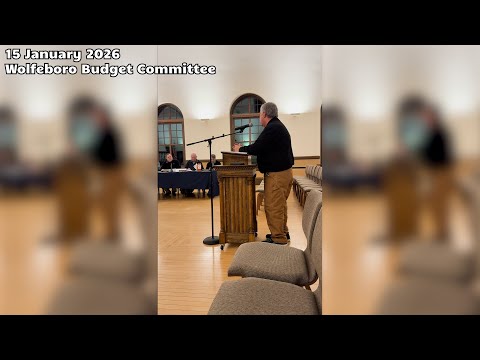
Wolfeboro Budget Committee reviews $35.9 million proposed 2026 budget; recommendation vote records a 4-4-2 split
Summary
At a meeting of the Wolfeboro Budget Committee, staff presented a proposed $35,913,502 2026 budget (a 6.72% increase). Members questioned enterprise-fund accounting, drivers of rising costs, and procedural presentation format; a committee vote on recommendation was recorded as 4-4-2.
At a meeting of the Wolfeboro Budget Committee, a staff presenter laid out a proposed $35,913,502 budget for 2026 — a 6.72% increase from the prior year — and committee members spent the session probing cost drivers, enterprise-fund accounting and voting procedure.
The committee’s Chair said the town has been on “a trajectory over the past 4 years of a 10% increase annually in our ending tax rate,” and called further increases “unacceptable,” emphasizing that many residents on Social Security face financial strain. The Chair also asked why enterprise funds (water, electric, sewer) are included in the operating budget and how the committee determines the amounts the enterprise funds contribute to the tax rate.
The staff presenter responded that after an initial round of submissions that would have produced larger increases, cuts and adjustments produced a proposed total of $35,913,502. “We made some cuts, got it down to 7.5% increase, and … you’re seeing a proposed budget of $35,913,502 or an increase of 6.72%,” the presenter said, and broke the total into a general fund portion of $20,409,255 (about 57% of the budget) and enterprise funds for water, electric and sewer.
Staff identified the primary drivers: wages (the 100 series, about $7,383,000 and an approximately 12.3% increase), health benefits and retirement (the 200 series, a roughly 12.3% increase), outside services and custodial/audit costs (the 300 series), utilities and insurance (the 400 series), and debt service (about $2.9 million combined). The presenter also noted enterprise funds are appropriated gross in the budget and then offset by enterprise revenues when the tax rate is set.
Committee members and participants pressed for clearer, more graphic explanations so residents can see how numbers evolved. One committee member said, “There’s a crazy health insurance market that’s driving the cost,” and others asked for historical context on enterprise-fund balances — for example, why an ice-rink account moved from roughly $100,000 to $69,000 and how projected revenue changes (longer skating season) affect fund balances.
A procedural dispute arose over how the budget should be presented. One member moved to follow the staff ("Jim's") presentation, with the presenter preparing both a department-by-department version and the alternate summary. The committee’s attorney (as referenced in discussion) advised that the committee should take a clear vote on any motion to "not recommend," and that motion language may need to be written precisely to reflect the committee’s intent.
Staff reported the committee’s recorded procedural vote as “4-4-2.” Members debated whether abstentions change a recommendation’s status and whether an abstaining member’s earlier vote altered the committee’s final recommendation. The meeting’s exchange as recorded in the transcript showed members calling roll and stating yes/no positions, though one readout in the transcript was unclear.
The presenter told the committee it would receive two budget versions at the next meeting on the 22nd — one laid out by department, and one in the alternate presentation — and members said they would dive further into individual departmental budgets at that meeting.
Next steps: committee members will review the two versions provided by staff on the 22nd and reconvene detailed departmental scrutiny; the transcript records a procedural vote (4-4-2) whose implications staff and the committee said may require clarified motion language and, if necessary, a revote.