Get Full Government Meeting Transcripts, Videos, & Alerts Forever!
Get email alerts on the Land Use topic
No spam. Unsubscribe anytime.
Committee reviews draft policy for use of city‑owned land
Summary
A Land Use & Planning meeting examined a draft policy that would standardize applications, review timelines and agreements for projects on city‑owned land, including a 10‑day completeness review, three tiers of public engagement and a proposed 30‑day appeal window.
The Land Use & Planning group reviewed a proposed policy on how the city will designate and change uses of city‑owned land, focusing on application requirements, review criteria and post‑approval oversight.
The committee walked through the packet with planner Jeremy Badness, who outlined required and optional application materials. "Depending on the project type and scale, application materials may include a narrative, project description, site plans and conceptual renderings, existing site photographs, construction details, engineering or technical studies where applicable," Badness said. He recommended grouping infrastructure impacts—traffic, parking, irrigation and utilities—into a single category for clarity.
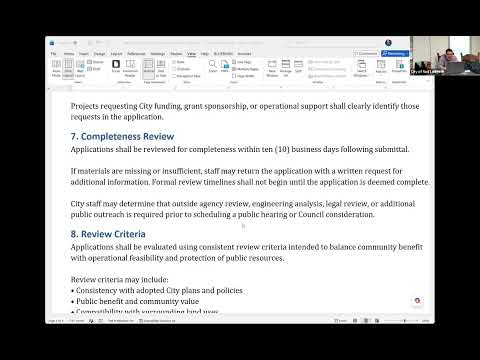
The draft sets a 10‑business‑day standard for staff to review applications for completeness, after which formal review begins only when the application is deemed complete. "This is just a completeness review to make sure we have all the pieces we need to start the process," Badness said. Committee members asked for confirmation that the timeline aligns with statutory requirements; the chair noted the provision was intended to prevent applications from languishing.
Review criteria in the draft prioritize consistency with adopted city plans, public benefit, compatibility with surrounding uses, preservation of public access, operational and maintenance impacts, financial impacts to the city, traffic and safety, environmental and infrastructure impacts, and historic or scenic compatibility. Committee members asked the planner to clarify "environmental" language; Badness said he intended "natural environment" impacts such as wetlands or floodplains and the group agreed to specify that wording.
The draft proposes three public‑engagement tiers: Type A (minor administrative), Type B (standard improvements) — with website posting, council agenda inclusion and opportunity for comment — and Type C (major legacy projects) — requiring at least a 30‑day comment period, a community meeting or open house, advisory board review and a public hearing before council. The planner said applicants may be required to fund extra outreach at the council's direction.
The policy also lists potential agreement types — permits, licenses, maintenance agreements, donation agreements, leases, development agreements and memoranda of understanding — and states the city attorney will determine appropriate agreement types. Committee members supported including performance or maintenance bonds or other financial guarantees to cover removal, restoration or future operational costs.
On appeals, the draft originally set a 15‑day window to appeal administrative decisions to council. Several members recommended extending that to 30 days to align with common practice and council schedules; the planner agreed the language should be changed to 30 days.
The committee discussed implementation details in the appendix review matrix, which assigns reviewers (planning department, public works, building inspector, police, fire, Carbon County historic preservation and the city attorney) on a project‑type basis and clarifies that necessary permitting still applies after council approval.
Committee members also debated fees for larger projects. The group did not adopt a new fee at this meeting; members favored implementing the policy first and adding a fee to the planning fee schedule later if staff time or outside consultant costs indicate a need.
The meeting concluded with the chair thanking planner Jeremy Badness for the work and stating the committee will proceed with edits (including clarifying environmental language and changing the appeal period to 30 days). No public comments were recorded. The committee adjourned.