Get Full Government Meeting Transcripts, Videos, & Alerts Forever!
Get email alerts on the Land Use Data Center topic
No spam. Unsubscribe anytime.
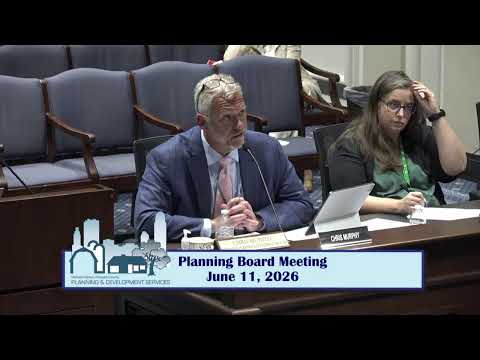
Planning board recommends denial of proposed Rural Hall hyperscale data center
Summary
The Winston‑Salem/Forsyth planning board voted 7–2 on June 11 to recommend denial of rezoning case F1669, a proposed 128.54‑acre hyperscale data center near Rural Hall, saying the project conflicts with the Forward 2045 and Bridal Hall area‑plan recommendations and raises noise, scale and compatibility concerns.
The Winston‑Salem/Forsyth City‑County Planning Board voted 7–2 on June 11 to recommend denial of rezoning case F1669, a proposal to rezone 128.54 acres near Bethania Rural Hall Road and Glade Street for a three‑building hyperscale data center campus.
Staff described the site and the proposal during a lengthy public hearing. The property, currently in largely residential and agricultural zoning, lies adjacent to a 150‑foot Duke Power transmission easement and contains two farm ponds and tributaries to Beaver Dam Creek. The applicants proposed three two‑story data center buildings totaling more than 1,100,000 square feet, outdoor equipment yards (135 ground‑mounted units in total) and screening conditions including closed‑loop cooling, landscaped buffers and noise monitoring. Staff said the site plan meets the technical UDO requirements but recommended denial because the proposal is inconsistent with the Bridal Hall area plan and Forward 2045 land‑use guidance.
The applicant’s representative, Michael Fess of the Montrose Group, argued the project would bring construction jobs and 150–250 permanent high‑wage positions, would not seek local incentives and would use closed‑loop cooling. “Data centers are a national security issue,” Fess said during the presentation, and he told the board the team had volunteered conditions to limit noise to 60 decibels at property lines and to install continuous noise monitoring on three sides of the site.
Residents and local stakeholders who opposed the rezoning cited the area plan’s mixed‑use recommendation and said a hyperscale data center would be an incompatible, high‑intensity industrial use immediately adjacent to neighborhoods and two churches. “To allow this property to be zoned limited industrial special use would be counterproductive in obtaining a more equitable, livable, and resilient future for a rural residential community,” Carol Newsom, a Rural Hall resident, told the board. Neighbors raised concerns about continuous low‑frequency noise, visual massing (the development includes screening walls and equipment that raise top elevations up to about 80–84 feet), and whether the site’s wetlands and stream crossings have been fully characterized for federal and state permitting.
Board discussion centered on compatibility with the Bridal Hall area plan and Forward 2045, the scale and massing of 80‑foot screening walls and buildings near existing homes, and whether the UDO and state law constrain the board’s ability to create a new zoning use specific to hyperscale data centers. Several board members said the area plan and the clear public opposition weighed heavily in their deliberations. Board member Farabee moved that the board find the request inconsistent with the comprehensive plan and then moved that the board recommend denial; the second motion passed 7–2.
The board recorded its recommendation to deny the rezoning request and will forward the recommendation, along with the record of conditions and public comments, to the Forsyth County Board of Commissioners. Staff said the county commissioners are preliminarily scheduled to consider the rezoning on July 30; that body makes the final decision on the special use rezoning.
What the board heard and what remains to be determined
- The applicants volunteered multiple conditions the developer says will run with the land if approved, including closed‑loop cooling (no open‑loop cooling), a 60‑decibel maximum at perimeter points, continuous noise monitoring, downcast and night‑sky‑compliant lighting, landscape buffers and limits on generator testing. The developer said Duke Power has confirmed capacity sufficient for projected power and the serving utility confirmed water capacity for the requested worst‑case fill; the applicant characterized routine daily water needs as much lower when closed‑loop cooling is operating.
- Opponents questioned those assurances: they stressed that the 60‑decibel standard still represents continuous, 24‑hour sound that some public‑health guidance treats as an annoyance threshold, that deciduous buffers will be less effective in winter months, and that some proposed “public recreation” acreage would remain privately controlled and gated unless the county or another public agency accepts it.
- Staff noted process limits under current state statute and the UDO: the board cannot unilaterally create a new use category for a hyperscale data center; historically similar facilities have been classified in the UDO as “Services A.” Staff also noted that some environmental and jurisdictional determinations (for wetlands and stream impacts) fall under state and federal permitting outside of the planning board’s checklist, and that the developer must obtain those permits if the project proceeds.
Next steps
The planning board’s recommendation is advisory. The record will be transmitted to the Forsyth County Board of Commissioners, which is expected to hold a public hearing (preliminarily scheduled for July 30) and make the final decision. If the commissioners approve the rezoning, the conditions volunteered by the developer would be enforceable as part of the special‑use approval; if the commissioners deny it, the rezoning would not take effect.