Get Full Government Meeting Transcripts, Videos, & Alerts Forever!
Get email alerts on the Transitional Living Plan Updates topic
No spam. Unsubscribe anytime.
NCDHHS rolls out updated LINKS and Chafee transitional-living forms and clarifies reimbursement rules
Summary
State LINKS and Chafee staff on a statewide webinar said new Transitional Living Plan and emancipation forms are live, outlined timing requirements (TLP within 30 days of a youth’s 14th birthday; emancipation planning 90 days before 18), and reviewed LINKS reimbursement caps and a monthly 5th-of-month submission deadline.
State staff from the North Carolina Department of Health and Human Services (NCDHHS) walked county LINKS and Chafee workers through updated Transitional Living Plan (TLP) and emancipation forms and explained changes to LINKS reimbursement procedures during a statewide webinar.
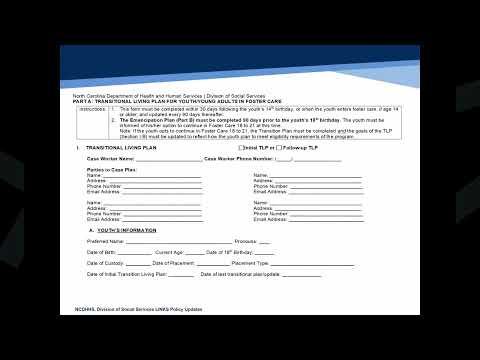
Tori Marshall, the State LINKS coordinator, told attendees “the forms are live for everyone” and demonstrated the new online, fillable layout while noting counties already using PATH NC may see different behavior in the system. She said the TLP Part A must be completed within 30 days after a youth’s 14th birthday (it was previously 13) or when a youth older than 14 enters foster care, and that plans should be reviewed and updated every 90 days.
Marshall emphasized the emancipation plan requirements for older youth: “Part 2 must be completed 90 days before their 18th birthday” for youth planning to exit care, and a copy of the most recent TLP Part A and the emancipation plan should be filed with the court for hearings on or after a youth’s 17th birthday. Shirley Williams, special programs manager overseeing foster care 18–21 and LINKS services, said the updated policy “shares different guidance and gives you different suggestions how to support young people in meeting different goals.”
On assessment and systems integration, presenters said a completed life-skills assessment is required before a county can access the TLP in PATH NC; counties already in PATH NC must ensure previously completed assessments are entered into the system or rekeyed so staff can proceed in PATH NC. Marshall asked counties with PATH NC–specific questions to follow up by email for technical support.
The webinar also covered what to record in the plans: goals and progress notes, strengths and supportive relationships (including community contacts and social-media touchpoints), housing plans and backup housing arrangements, education status and IEP/504 considerations, employment and training resources, and medical/health-care contacts. Presenters urged teams to document responsible parties and referral dates for services.
On reimbursements, Marshall reviewed the updated LINKS reimbursement form and told counties to submit separate totals for housing and transitional funds and to include the county name on the form. She summarized dollar limits included on the training slides: housing assistance for youth 18–21 may cover rent, deposits or down payments up to $1,500 per youth per fiscal year; transitional supports tied to LINKS outcomes may be reimbursed up to $3,000. She said a new “one-time special allowance” column will appear on the form but should be used only when the division has announced specific special funds.
The division set a firm schedule for claims: LINKS reimbursement requests are due by the 5th of each month; late submissions may not be reimbursed in the subsequent month. Marshall acknowledged a March reimbursement delay tied to a finance/system issue and said counties should contact her if they did not receive March or April payments together.
Marshall gave guidance on NYTD reimbursements (those should be submitted separately this fiscal year and are counted against transitional funds, not the one-time allowance) and listed examples of allowable purchases when tied to outcomes, such as vehicle matching, tutoring, sports equipment, summer camps and job-related items.
Counties raised technical questions in the webinar about whether the online form is fillable and how PATH NC handles form parts; presenters answered on the call and invited counties to request one-on-one technical assistance or attend an upcoming in-person LINKS call in Region 3 (Greensboro). Marshall said the updated slides and forms would be posted to the LINKS listserv and reiterated that counties should email specific PATH NC reimbursement questions directly to her.
The presenters closed by encouraging counties to keep lines of communication open, to re-run life-skills assessments when missing, and to document supports and responsible contacts so youth have clear plans and agency points of contact as they approach adulthood.