Get Full Government Meeting Transcripts, Videos, & Alerts Forever!
Get email alerts on the School Based Behavioral Health Grants topic
No spam. Unsubscribe anytime.
Kentucky announces SHINE KY local school grants; $700,000 available for LEAs to expand school-based behavioral health
Summary
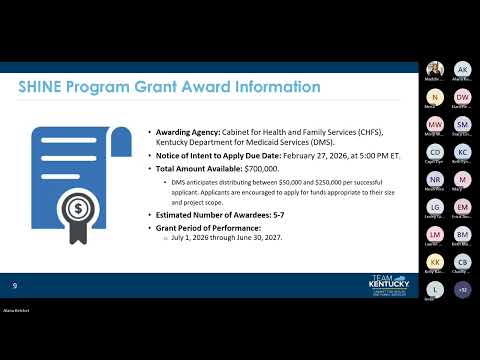
The Kentucky Department for Medicaid Services outlined a competitive SHINE KY local grants program funded from a federal school‑based services enhancement award. Eligible local education agencies may apply for $50,000–$250,000 to support workforce, technology, or partnership projects; applications are due March 13.
The Kentucky Department for Medicaid Services on a webinar announced a local grants competition under its SHINE KY program, opening a $700,000 pot for school districts to expand school-based behavioral health services.
Leslie Hoffman, deputy commissioner at the Department for Medicaid Services, and webinar moderators said the local funding is part of a larger $2.5 million federal school-based services enhancement cooperative agreement the department received. "Kentucky's Department for Medicaid Services ... is so very excited to launch this one-time grant opportunity," Hoffman said.
The grant program will award between $50,000 and $250,000 per successful applicant, with an estimated five to seven awardees. The one‑year performance period runs July 1 through June 30, 2027. A notice of intent to apply is due Feb. 27 at 5 p.m. Eastern, full applications are due March 13 at 5 p.m. Eastern, and applicants will be notified of awards on May 1.
The grant is limited to local education agencies (LEAs) and LEA collaborations; community providers are not eligible. Presenters emphasized that applicants should already be an "expanded access" provider, or must show documentation that an application to become one was submitted prior to applying for the SHINE NOFO.
Presenters identified three priority programmatic areas for funding: workforce capacity and training (for example, hiring coordinators or building staff capacity to manage expanded behavioral health services), technology adoption (documentation, billing systems, telehealth), and program expansion partnerships and education (for instance, collaborations with educational cooperatives to broaden service offerings and increase enrollment).
Webinar moderators cautioned about a key restriction on allowable costs: the state grant cannot be used to pay salaries or contracts for Medicaid‑enrolled providers who will bill Medicaid for services during the grant period. "You cannot use the funds to support Medicaid enrolled providers that are going to seek Medicaid reimbursement during that grant period," the presenter said. However, applicants may request funds to hire staff who coordinate billing or train staff on billing practices, provided those funded staff do not themselves bill Medicaid for services during the grant period.
DMS will require monthly status reports and a final report submitted within 90 days after the grant period ends; templates will be provided and grantees must attend monthly one-on-one and cohort meetings for technical assistance and progress reporting. Questions submitted during the webinar will receive written answers and be posted at the NOFO link by March 2; slides and a recording of the webinar will also be posted.
Participants asked whether credentialing costs (to become billable providers) would be an allowable use; a presenter pointed attendees to the technical assistance guide online that lists qualified providers and billing guidance. Presenters also confirmed flexible application arrangements for collaborating LEAs: districts may submit a joint application if the project and costs are shared or separate applications if projects are independent.
The webinar ended with a reminder of deadlines and instructions for submitting the notice of intent and application materials to the email listed with the NOFO. Organizers encouraged rural districts and collaborations among LEAs to apply in order to leverage the funding and build sustainable systems for school-based behavioral health.