Get Full Government Meeting Transcripts, Videos, & Alerts Forever!
Get email alerts on the Haiti Security Elections topic
No spam. Unsubscribe anytime.
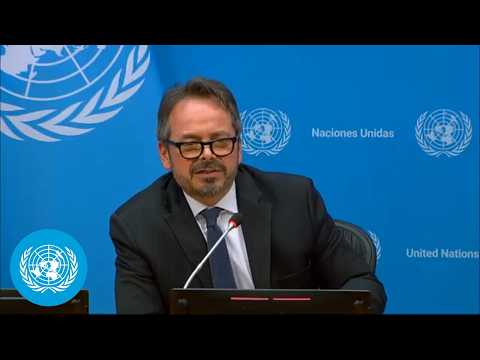
Carlos Ruiz Masseur says Security Council backs new GSF operations and urges political steps to secure elections in Haiti
Summary
Carlos Ruiz Masseur, head of the UN political mission in Haiti (BINU), told reporters the Security Council gave "a clear expression of unanimous support" for collective efforts; he said GSF operations began last month and stressed that security gains must be paired with political progress, voter registration and DDR programs to protect children and enable elections.
Carlos Ruiz Masseur, head of the United Nations political mission in Haiti (BINU), told reporters during a press briefing that the Security Council gave "a clear expression of unanimous support" for international efforts to stabilize the country and that recent security steps must be matched by political progress to allow elections to proceed.
Carlos said the Global Security Force (GSF) began operations last month and that the UN is working simultaneously on humanitarian, security and political tracks. "We have that there is a window of opportunity, but that we need to seize," he said, adding that gains must be made sustainable so "we don't go back after getting some positive results." (Carlos Ruiz Masseur, head of BINU)
Why it matters: Haiti is facing a multifaceted crisis of insecurity, humanitarian need and disrupted governance. Carlos said improved security alone will not suffice and that elections require minimum conditions — secure campaigning and the ability of citizens to vote — which in turn depend on logistics, registration and political agreement on timing.
On elections and logistics, Carlos said UN agencies are supporting the electoral authority: "UNDP is pretty much helping the CEP, the electoral council in managing its budget," and "UNOPS is helping in the logistic of elections, and on the operational aspects going forward." He noted a border registry process had been announced as starting July 20 and said the UN is coordinating international support for transportation of sensitive electoral materials if needed.
Arms flows and tracing: Reporters pressed about weapons reaching gangs in Haiti. Carlos said the UN has an arms embargo and a sanctions-committee panel that gathers information, and that seized weapons will be cross-checked with "a system that is called eTrace" so authorities can trace origins and urge source countries to strengthen controls. He said the UN expects significant seizures "in the near future" and aims to strengthen measures to reduce the flow of weapons into Haiti.
Protecting children and DDR: Asked how to keep children from being swept up in gang recruitment, Carlos described a twofold approach: engagement with armed groups to seek the release of minors, and operations that may recover children, followed by channeling minors through social services and UNICEF transition centers for psychosocial support. He said recovered youth would be linked to DDR and vocational training to reduce risk of re-recruitment. "Minors ... are victims 1st and foremost," he said.
Governance and timing: On who governs during the transition, Carlos said a transitional government led by the prime minister is in place under an agreement among political forces and will remain until elections can restore elected authorities. He emphasized that the authority and timing of elections are constrained by security conditions and logistical needs: "the main issue is ... what are the minimum conditions under which elections could happen."
Numbers and locales: When asked which areas are most insecure, Carlos named the West Department (including Port-au-Prince), Artibonite and Centre, and said those departments account for about 54–55% of the current registered electorate. He said he had been told the voter-registration start date had been announced as July 20 but that he would verify that operationally.
What remains unresolved: Carlos and reporters repeatedly framed the situation as contingent: the UN is coordinating support and has technical means for tracing weapons and assisting elections, but many details — the full deployment strength of GSF, operational start of registration and the timing for a safe election — remain to be confirmed. Carlos said Security Council members visiting the country can provide important perspective, and the UN is considering a council visit when conditions allow.
The briefing concluded with a reminder from the moderator that Carlos Ruiz Masseur is head of BINU, the UN political mission in Haiti, and that he had just briefed the Security Council. The UN official said he would share clarification on the registration start date as soon as possible.