Get Full Government Meeting Transcripts, Videos, & Alerts Forever!
Get email alerts on the School Referendum topic
No spam. Unsubscribe anytime.
Advisor presents preliminary $227.9 million referendum plan; board hears conservative tax-impact estimates
Summary
A Phoenix Advisors representative told the Livingston Board of Education that a preliminary package of projects totals about $227.9 million, with roughly $60.8 million in renovation work eligible for debt-service aid; using conservative assumptions the advisor estimated an illustrative tax impact of about $1,000 per average assessed home (preliminary).
Sherry Tracy of Phoenix Advisors told the Livingston Board of Education that the package of projects the district is considering for a potential referendum totals about $227,900,000, divided into new construction, roughly $60,800,000 in renovations and separate site work.
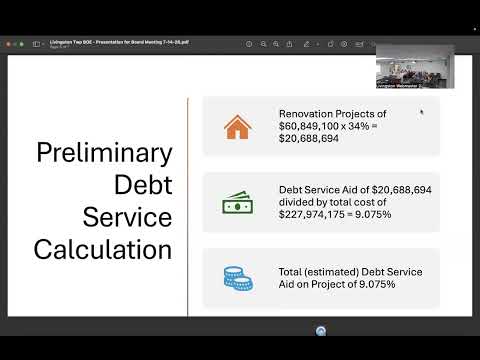
Tracy said renovation work is eligible for up to 40% state debt-service aid on paper, but the state has for the last 15 years appropriated about 85% of that promise; for modeling she used a working aid rate of about 34%. "On the $60,800,000 renovation piece, that equates to about $20,600,000" in preliminary state aid, she said, and emphasized that nothing had yet been submitted to the state for review.
Using conservative bond assumptions (25- and 30-year repayment examples and interest-rate assumptions in the low- to mid-4% range), Tracy presented illustrative taxpayer impacts. She said the district’s total assessed ratable base is just over $8.7 billion and that a 25-year schedule produced roughly 15.5¢ per $100 of assessed value (about $155 per $100,000 assessed). Using the board’s modeled average assessed home value ($729,002.72), her 25-year example produced an illustrative per-household impact of about $1,001.29; a 30-year example was slightly lower per year but carries debt longer.
Board members pressed for detail on which parts of the work would qualify for state aid and whether site work (for example, turf fields with drainage) would be eligible. Tracy said architects had already broken out soft costs (she noted preliminary soft-cost assumptions around 30% of project totals) and that the state allocates aid on the total eligible cost, including approved soft costs. She also said site-work eligibility is often limited but that components such as drainage sometimes qualify.
Tracy described the state application process: architects submit project applications and the state generally issues preliminary eligible-cost letters after a review cycle she estimated at about 4–6 months (90 days is typical but can be extended). She warned the board that her numbers are preliminary and conservative: "All the numbers we talked about are in fact preliminary," she said.
On refinancing and bond terms, Tracy said term-selection (25 vs. 30 years) is decided after voter approval and bond sale; districts commonly include a 7‑year call provision that allows refinancing if rates fall. She said Livingston has been active in refinancing past issues to reduce long-term costs.
The board did not take action on the referendum at the meeting. Staff said they will return with additional breakdowns (soft-cost detail, growth scenarios for ratables and any state-eligibility letters) at the next meeting or when architects complete applications. The board and advisor emphasized that the figures should be treated as preliminary until the state issues formal eligibility letters.