Get Full Government Meeting Transcripts, Videos, & Alerts Forever!
Get email alerts on the Energy Infrastructure topic
No spam. Unsubscribe anytime.
Sunflower, Wheatland explain how large electrical loads connect, who pays and the timing for upgrades
Summary
Sunflower Electric and Wheatland Electric told the Finney County Commission how data centers and other large customers are studied and connected through SPP interconnection and transmission studies, who bears upgrade costs and why some projects can take years to reach full service.
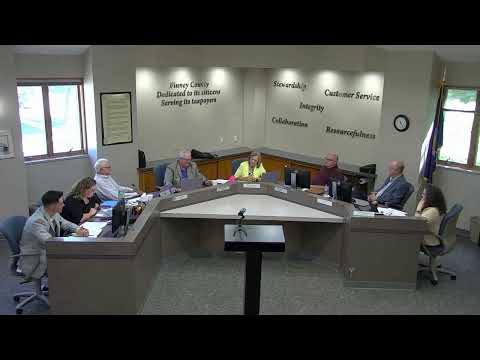
Sunflower Electric and Wheatland Electric told the Finney County Board of Commissioners on July 20 that connecting very large electrical customers requires multiple studies, contractual protections and often substantial construction that can take several years.
Corey Linville, Sunflower’s chief operations officer for power supply and generation, walked commissioners through the technical steps: resource-adequacy checks, transmission-service studies, generator interconnection and both steady-state and transient analyses. Linville said the process was tightened after winter storm Yuri in 2021 and that SPP’s resource adequacy rules now require large loads to demonstrate accredited generation capacity. “SPP is a regional transmission organization,” Linville said, describing its role in studying interconnection requests and administering the open-access transmission tariff.
Jim McVay of Wheatland Electric said the local distribution provider and Sunflower coordinate to protect member co-op customers and to price risk. He said 100% of costs for direct interconnection facilities are paid by the connecting customer, while higher-voltage transmission upgrades may be allocated across the SPP footprint by load-ratio share. “If we have to upgrade that facility…we can’t support that under that condition. We have to upgrade that facility,” McVay said, describing n-minus-1 contingency studies that can reveal required reinforcements.
Presenters emphasized that for loads above 50 megawatts Sunflower and its members require the customer to provide generation or accredited capacity, post substantial security and accept special retail electric service terms. Linville summarized the commercial path as a three-phase process: a high-level feasibility phase, a study-and-estimate phase, and a final execution-and-construction phase. He warned that equipment lead times and construction windows mean that major upgrades “can take 2, 3, 4, 5 years sometimes to build.”
Wheatland staff also highlighted community outreach efforts. Ally (member services) said the co-op has distributed postcards, bill inserts and a dedicated website explaining why service cannot be refused inside a territory and describing cost responsibilities. Luke West, director for Wheatland’s water division, told the board Wheatland also considers local water impacts in its assessments and serves wholesale customers including Garden City and Tyson Foods.
What’s next: presenters said several clustered projects in the region are in SPP phase 2 engineering studies; the utilities recommended that residents with questions contact Wheatland’s public-facing staff or Sunflower’s economic development manager for details and contact information.