Get Full Government Meeting Transcripts, Videos, & Alerts Forever!
Get email alerts on the Mental Health Services topic
No spam. Unsubscribe anytime.
NC DHHS explains how to use RSVP referral tool for Transitions to Community Living
Summary
State DHHS webinar walked providers and guardians through the RSVP web referral used since Nov. 1, 2018 to screen Medicaid-eligible adults with serious mental illness for community placement; presenters explained who must be referred, consent rules, how to complete the form, and where to get help.
A North Carolina Department of Health and Human Services (DHHS) webinar reviewed the RSVP web referral process that the agency uses to screen Medicaid-eligible adults with serious and persistent mental illness for community-based services through the Transitions to Community Living (TCL) program.
Dr. Tamara Smith, community transitions and integration team lead in DHHS’s Division of Mental Health, Developmental Disabilities and Substance Abuse Services, opened the session and said the RSVP tool has been in use since Nov. 1, 2018 to divert individuals from admission to adult care homes when community supports are appropriate. "The purpose of TCL…is to make sure that people living with serious and persistent mental illness are able to live in communities alongside other North Carolinians," she said.
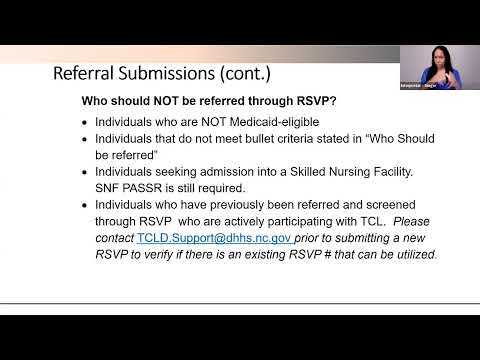
The webinar explained who must be referred. Smith said that under state law, a referral is required for any Medicaid-eligible person being considered for admission to an adult care home (General Statute 131D‑2.4). She noted that admissions to licensed mental health group homes, ICF/IID group homes, and certain unlicensed homes are not covered by the RSVP requirement and that skilled nursing admissions follow separate PASRR procedures.
Stacy Lee, RSVP diversion lead, demonstrated completing an RSVP referral online. Key points from the walk-through: the form requires referrer contact information (recommended to include an email and phone number), the referred individual’s full name and date of birth, a Medicaid ID number or the last four of a Social Security number if the Medicaid ID is not available, the Medicaid county, current location, admission date (when applicable), and any known diagnoses. Lee showed selecting reasons for referral (including personal care services), indicating Medicaid status (yes, pending, or unknown), and how the system displays the LME‑MCO that will perform screening (for example, Alliance Behavioral Healthcare when Wake County is selected).
The presenters emphasized practical steps and limits: RSVP is web-based and requires only internet access (compatible with Chrome, Firefox, Edge and Internet Explorer 11+); the system cannot accept uploaded collateral documents, so providers should supply contact details so screeners can collect records; and printed confirmation of the RSVP referral ID should be saved in patient records. Lee demonstrated the verification screen and the final submission page that contains the RSVP referral ID and the assigned screener contact information.
On consent, Dr. Smith said that if a person has a guardian of the person (not guardian of the estate), that guardian must provide verbal or written consent before a referral is submitted; if consent is verbal, the referrer should document it in the referral record.
For technical assistance and questions, presenters directed users to tcld.support@dhhs.nc.gov and linked resources shared during the webinar: the RSVP referral web page, an RSVP FAQ, the TCL settlement agreement, and NC Medicaid clinical coverage policy 3‑L on personal care services. Smith closed by noting DHHS reports diverting over 2,500 people from adult care homes through TCL and thanked attendees.
The webinar recording and the linked resources provide step-by-step guidance; DHHS advised using the electronic submission option when possible because paper submissions (mail or fax) are subject to a processing delay and require staff to enter the referral into RSVP before an ID is available.